
This page lists minor characters featured in Vertigo's Fables and its spin-off titles, published by DC Comics.
Contents
A B C D E F G H I J K L M N O P Q R S T U V W Y Z
A
Aunty Em
| Aunty Em is a Fable who is mentioned in Cinderella: Fables Are Forever #4 — "Part Four." Dorothy Gale mentions her aunt, stating that she said "you should find something you love to do and then do it." Dorothy, having killed two witches and liking it, was inspired to become a killer for hire. | |
Original source
| |
B
Bandarlog
| The Bandarlog are a group of Fables who live at the Farm. King Louie, the only member of the Bandarlog who is actually seen, debuts in Fables #7 — "The Guns of Fabletown: Part Two of Animal Farm," where he informs Kaa that he has the entire Bandarlog scouring the forest for Reynard the Fox, who is being hunted by Goldilocks' revolutionaries. | |
Original source
| |
Baron Ryald
| Baron Ryald is a Homelands character who appears in Fables #97 — "Dark Age Party Girl, Chapter Four of Rose Red." | 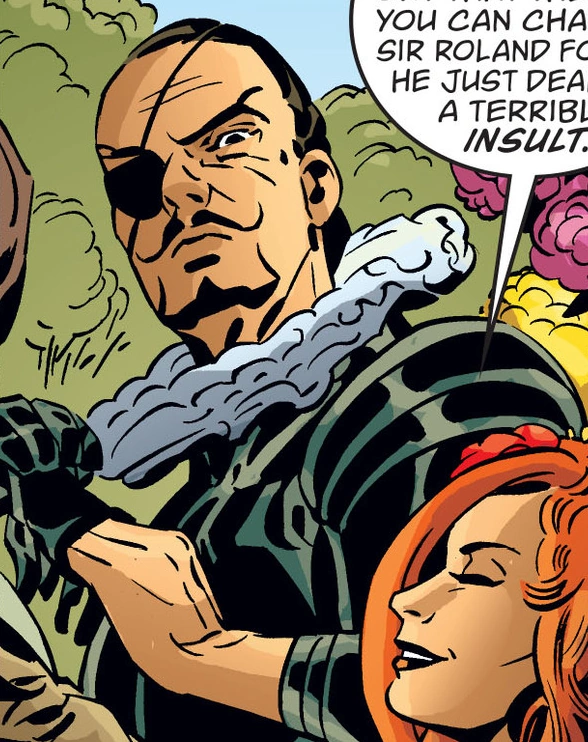 |

Benjamin Bunny
|
|
 | |
Original source
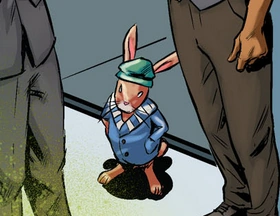
He is based on the character of the same name from from The Tale of Benjamin Bunny and other children's books by Beatrix Potter. | ||

Bigfoot
|
|
 | |
Original source
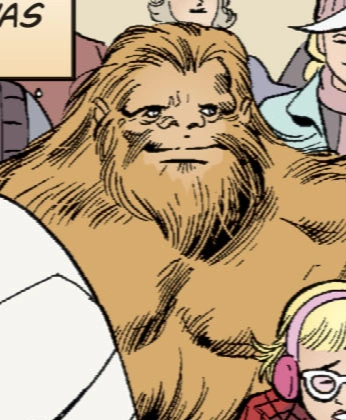
They are based on Bigfoot, also known as Sasquat, a large, hairy, humanlike cryptid said to exist in forested areas of Northwestern United States and Western Canada, which appears to be the North American counterpart of the Himalayas' Abominable Snowman, or Yeti.[2] | ||

Black Caroline
| Black Caroline is a Fable imprisoned at the Golden Boughs Retirement Village. She is mentioned in Jack of Fables #1 — "The Long Hard Fall of Hollywood Jack," where Gary refers to the cottage that Jack Horner moves into as "Black Caroline's place." | |
Original source
Black Caroline is based on one of the titular characters of the fairy tale "White Caroline and Black Caroline" by Edmund Dulac, from Edmund Dulac's Fairy-Book. | |
The black sheep and the little boy
|
|
 | |
Original source
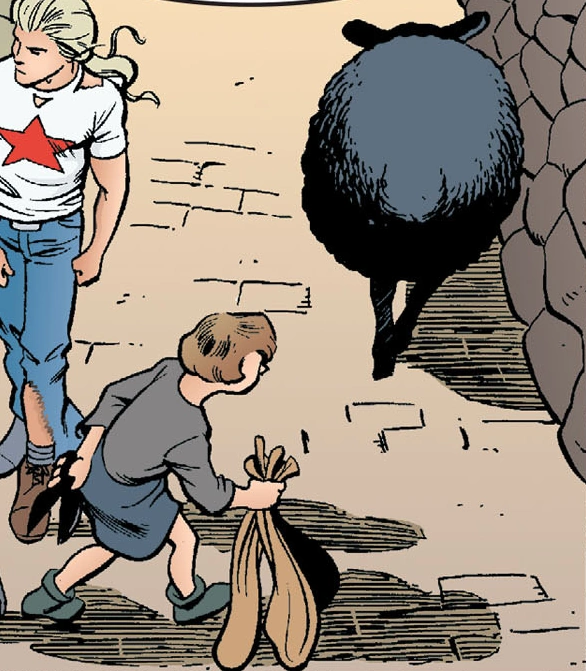
They are based on the characters from the nursery rhyme "Baa, Baa, Black Sheep." | ||

The boy who cried wolf
Original source
He is based on the titular character of "The Boy Who Cried Wolf," one of Aesop's Fables. | ||
Brave little tailor
|
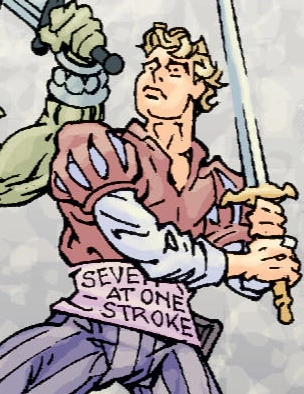
The brave little tailor,[3] also known as the valiant little tailor,[4] appears in flashbacks from the Homelands in Fables: The Last Castle. He is identified through the text on his clothes, which says, "seven at one stroke." He was killed by goblins early in the battle at the Last Free Gateway from the Homelands. In addition, his name can be seen on one of Kevin Thorn's books in Jack of Fables #13 — "The Bad Prince, Part 2: I Forget." |
 | |
Original source
He is based on the little tailor from the fairy tale "The Brave Little Tailor," also known as "The Valiant Little Tailor." | ||

Brer Bear
|
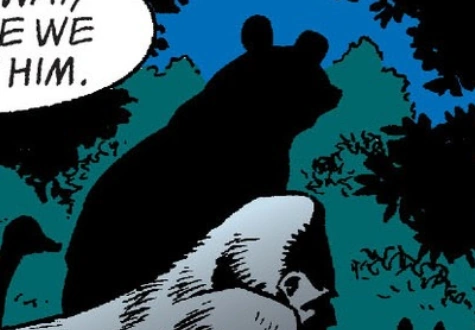
Brer Bear is a Fable that resides at the Farm. He appears in silhouette in Fables #7 — "The Guns of Fabletown: Part Two of Animal Farm," taking part in Goldilocks' search for Reynard the Fox at night. Brer Bear leads one team, while Br'er Rabbit leads the other, in a classic pincer movement. |
 |
Original source
He is based on Br'er Bear, also spelled Brer Bear, from American folklore, and the tales of Uncle Remus. | |
Trivia
In the Fables Encyclopedia, his name is spelled as "Br'er Bear,"[5] but the comic says "Brer Bear."[6] | |

Briar Rose's parents
 | ||
History
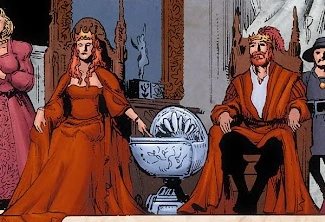
Unhappily childless for many years, a grand celebration was held in honor of their newborn daughter, Briar Rose. Fairies from the nearby Twilight Lands attended to bestow the baby magical blessings. Upset at not being invited, the dark fairy Hadeon cursed Briar Rose to prick her finger and die. Leysa the Defender used her power to mitigate the curse so that instead of death, Briar Rose would fall into a deep sleep that spread to those near her, with true love being the way to reset the curse. | ||
Original source
They are based on the King and Queen from the "Sleeping Beauty" fairy tale. | ||

The Bubblehead Family
| The Bubblehead Family first appears in Everafter: From the Pages of Fables #1 — "The Show Me State: Chapter One of The Pandora Protocol." Hailing from St. Louis North Country, they were among the many figures from St. Louis folklore that Jordan Yow raised from the collective unconscious.[7] | 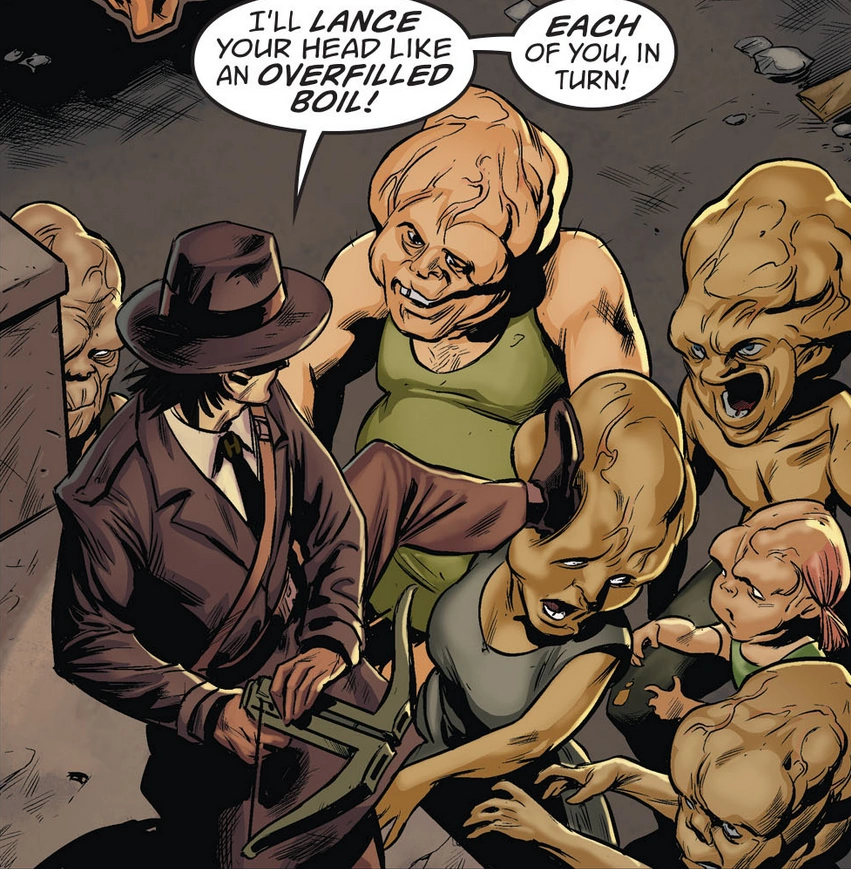 |
Original source
The Bubblehead Family are based on the Bubbleheads from an urban legend from St. Louis.[8] | |

C
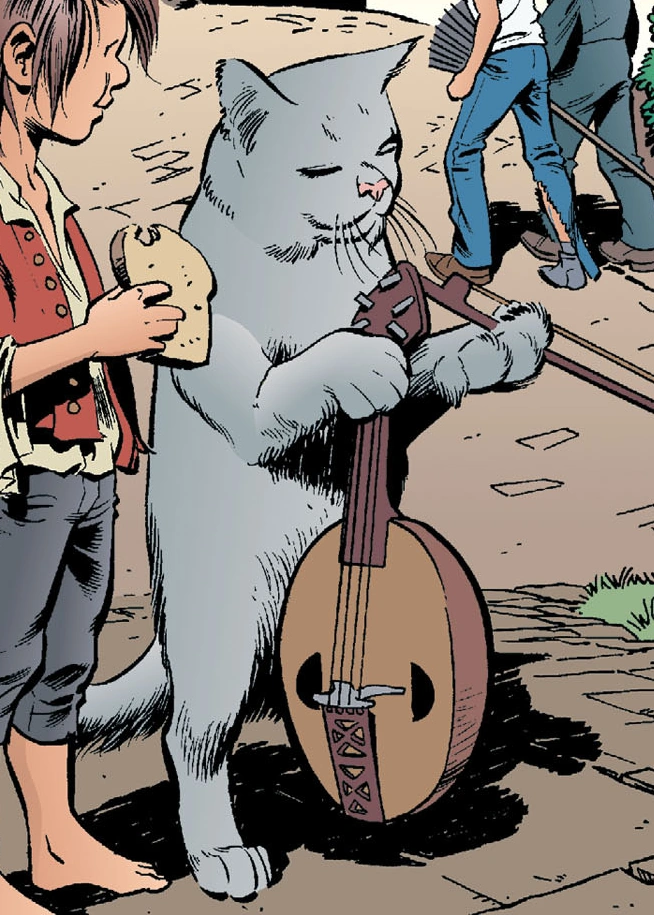
The cat and the fiddle
|
 | ||
Original source
They are based on the character of the same name from the nursery rhyme "Hey Diddle Diddle." | |||

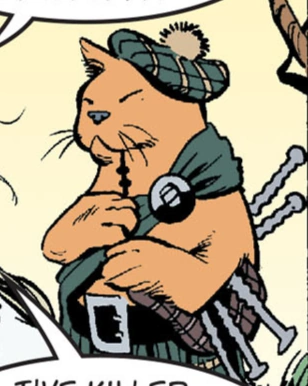
The cat with bagpipes
|
|
 | |
Original source
They are is based on the titular character of the nursery rhyme "A Cat Came Fiddling." | ||

Cendrée
| Cendrée is a Homelands character who appears in flashbacks in the graphic novel Fairest: In All the Land. He was an enchanter and blacksmith who forged the Maerorgladi. | 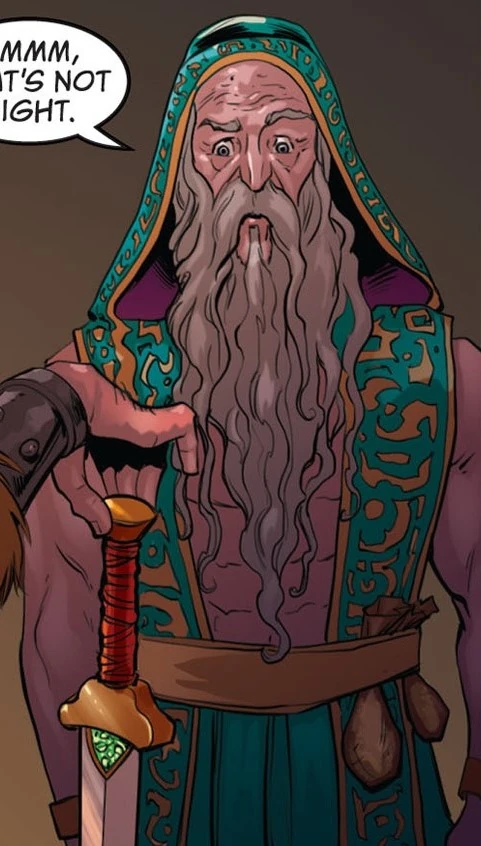 |

Charlene Speck
| Charlene Speck is a mundy woman who appears in Fables #34 — "Jack Be Nimble: Part One of Two" and Fables #35 — "Jack Be Nimble: Part Two of Two." She works for Jack Horner's film studio, Nimble Pictures. | 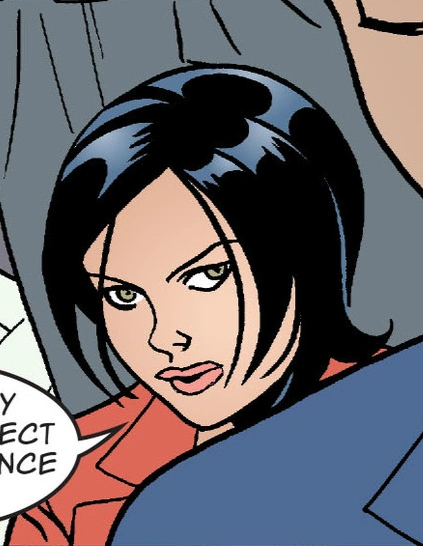 |

Cheshire Cat
| The Cheshire Cat is a Fable that resides at the Farm. It appears in Fables #6 — "Road Trip: Part One of Animal Farm," and is mentioned in Cinderella: Fables Are Forever #3 — "Part Three." | 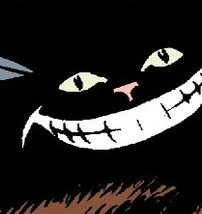 |
Original source
The Cheshire Cat is based on the character of the same name from Alice's Adventures in Wonderland. | |

Chicken Laundress
| Chicken Laundress is a Fable imprisoned at the Golden Boughs Retirement Village. She is referred to in Jack of Fables #1 — "The Long Hard Fall of Hollywood Jack," where Priscilla Page mentions that she works in the clothing comissary. | |
Original source
She is based on the titular character of "The Chicken Laundress," an Italian fairy tale by Italo Calvino.[9] | |
The cobbler
 | ||
Original source
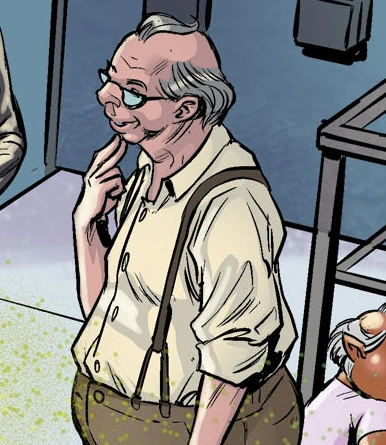
The cobbler is based on the shoemaker from "The Elves and the Shoemaker," a fairy tale by the Brothers Grimm. | ||

Cobweb
| Cobweb is a Fable fairy who is imprisoned at the Golden Boughs Retirement Village. She first appears in Jack of Fables #3 — "You Don't Know Jack." | 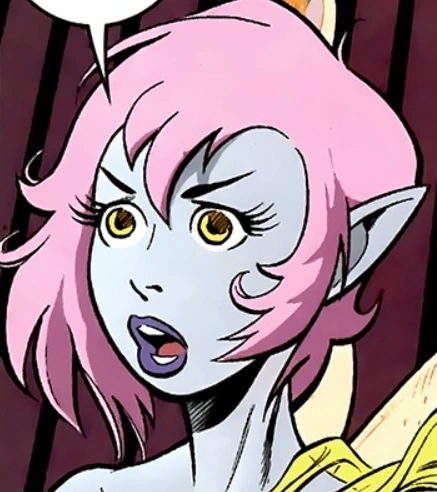 |
Original source
Cobweb is based on the character of the same name from William Shakespeare's play A Midsummer Night's Dream. | |

Cottingley Fairies
| The Cottingley Fairies are two Fable fairies who are prisoners at the Golden Boughs Retirement Village. They first appear in Jack of Fables #3 — "You Don't Know Jack" and are a lesbian couple named Lola and Doris. | 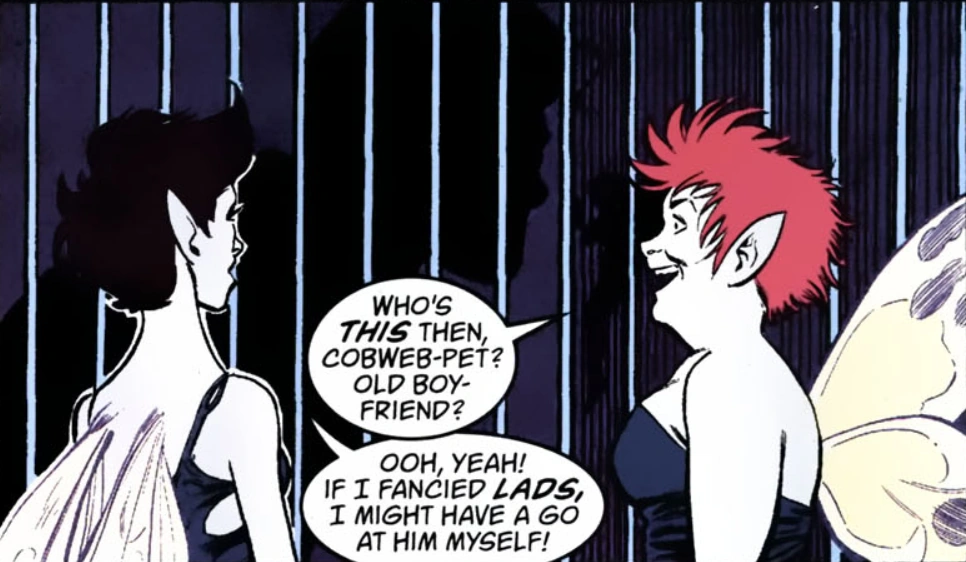 |
Original source
These characters are based on the Cottingley Fairies hoax from 1917. | |

Coyote
| Coyote is a Fable mentioned in Fables #110 — "Allies: Chapter Three of Inherit the Wind." He is one of the many Fables that the West Wind has had to deal with in the Lands of the West. According to the West Wind, wolves such as Bigby can be as cunning as "Coyote himself" when pressed. | |
Original source
Coyote is a character from Native American mythology. He takes on many roles, serving as a creator, lover, magician, glutton, and trickster figure. He is often depicted as a demiurge (an independent force of creation), making fateful decisions and providing humans with essential elements like fire and daylight. He is also credited with introducing art to humanity. In every instance, his violation of accepted social norms leads to chaos and disorder, which is eventually resolved by the end of each folktale.[10] | |
The crow
|
|
 | |
History
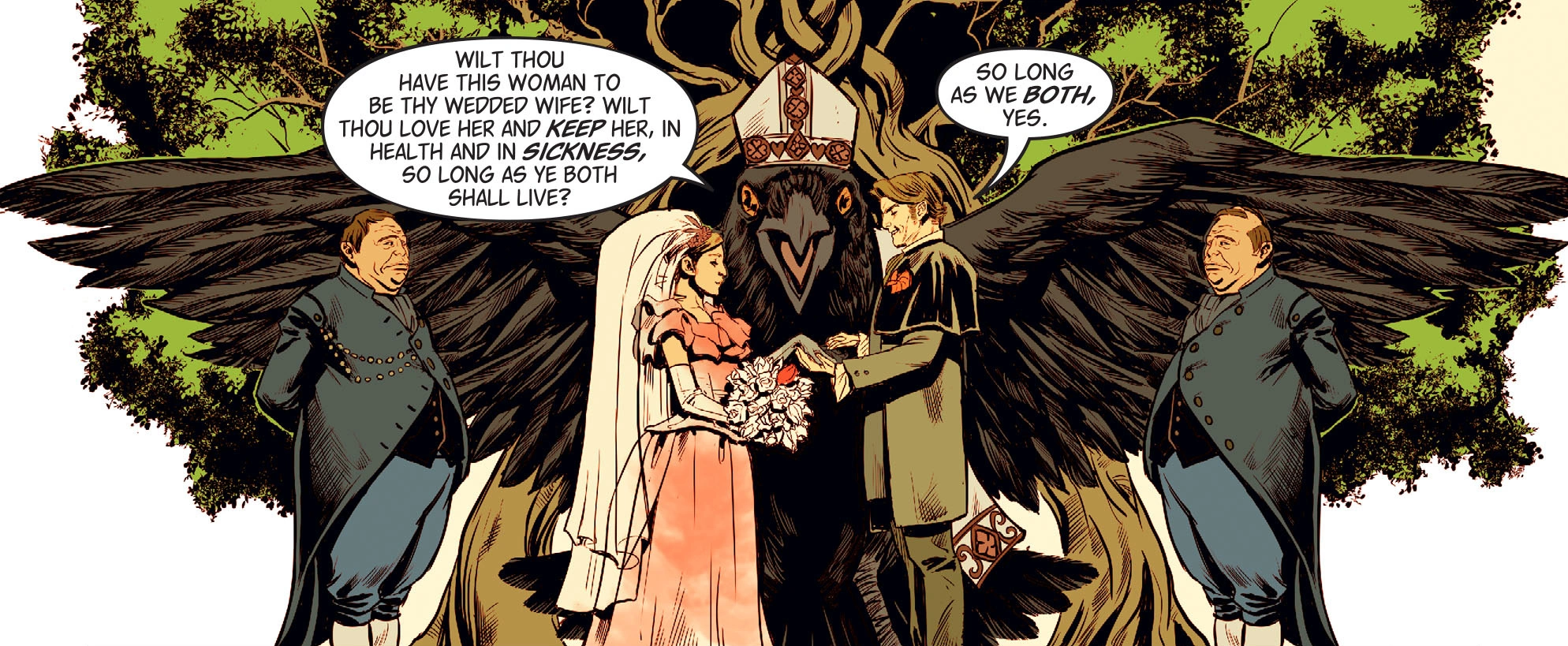
The crow officiates the wedding between Mary and the Knave of Hearts, with Tweedle Dee and Tweedle Dum acting as witnesses. It is later set to officiate the wedding between King Edward and his chosen bride in Fables: The Wolf Among Us #47 — "Chapter Forty-Seven." | ||
Original source
The character is based on the monstrous crow from the nursery rhyme of "Tweedledum and Tweedledee," and the monstrous crow from the novel Through the Looking-Glass, which adapts the poem. According to the rhyme, the crow is "black as a tar-barrel" and of a monstrous size. In the novel, the Tweedle brothers are terrified of the crow, and while they're talking to Alice, it gets dark so suddenly that the latter thinks there must be a thunderstorm coming. What looks like a thick black cloud with wings, comes fast, and Tweedle Dee and Tweedle Dum run away in terror. When daylight returns, Alice is convinced that the crow must have flown away. | ||

The Crow brothers
| The Crow brothers[11][12] are a group of twelve human Fable brothers who can transform into crows. They first appear in a flashback from the Homelands in Fables: The Last Castle. Out of the twelve, only Ephram, Joel and Vulco Crow survived and made it to the mundane world. | 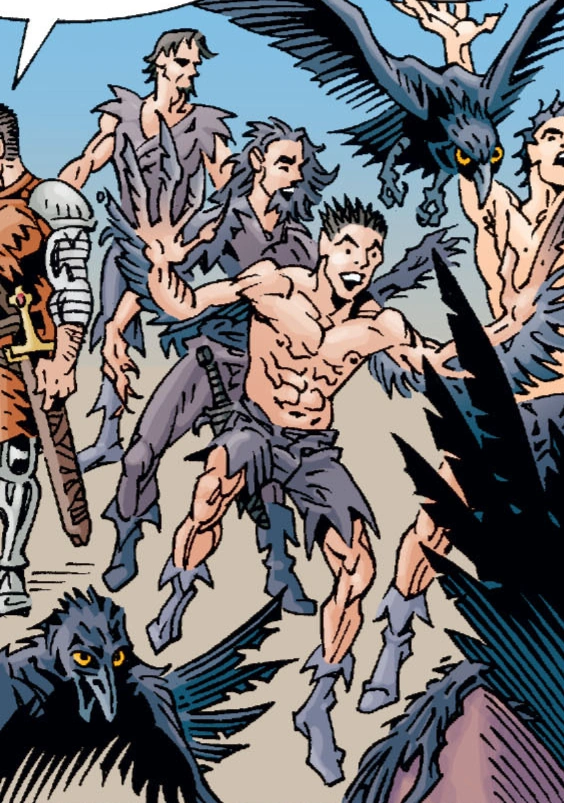 |
Original source
The Crow brothers are based on the titular characters of the fairy tale of "The Twelve Brothers." | |

D
Dallas Goat Man
 | ||
Original source
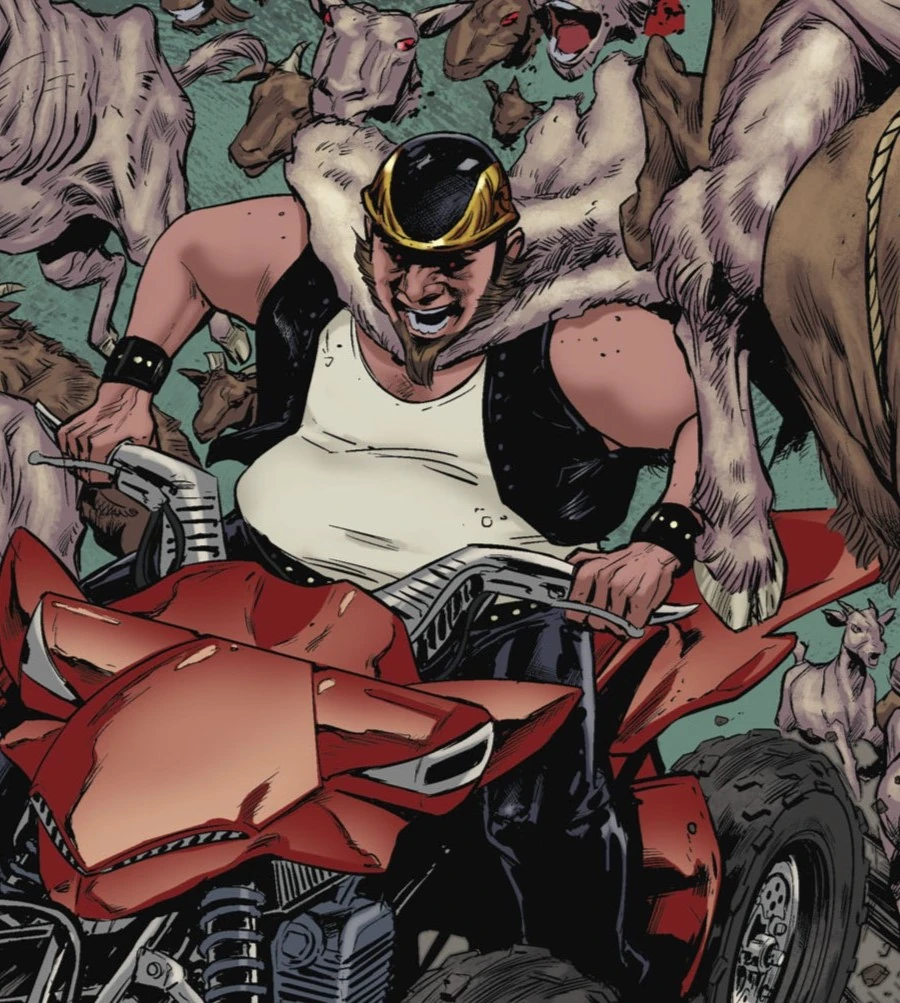
He is based on the Lake Worth Monster, also known as the Goatman, from Texan folklore. | ||

Daedalus
| Daedalus is a human Fable who appears in a brief flashback from ancient times in the Homelands, in Fables #43 — "Arabian Nights (and Days), Chapter Two: D'jinn & Tonic with a Twist." He was the greatest sorcerer-scientist of that age, and was the inventor of the capture bottles used to imprison d'jinns. | 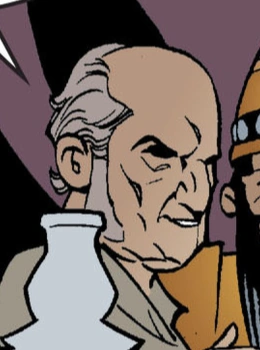 |
Original source
Daedalus is based on the character of the same name from Greek mythology. He was an inventor, architect, and sculptor, credited with constructing, among other creations, the Labyrinth used to confine the Minotaur.[13] | |

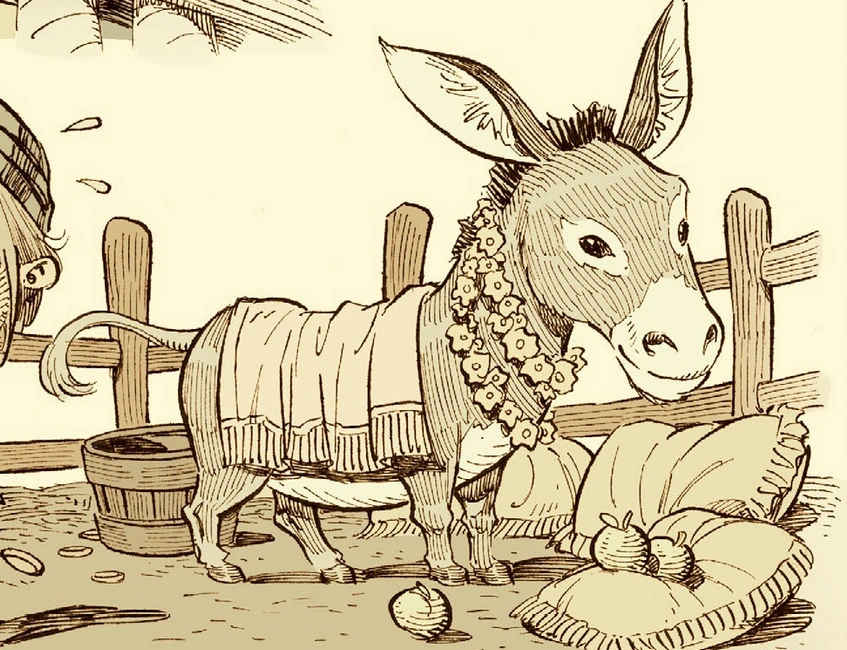
The donkey that passed gold
 | ||
Original source
The donkey that passed gold is based on the donkey from the fairy tale "Donkeyskin" by Charles Perrault. | ||

Don Quixote
| Don Quixote[14] is a Fable that appears in a brief flashback from the Homelands in Fables #4 — "Chapter Four: Remembrance Day," appearing in a single panel alongside Sancho Panza as they watch as ships come in after the Adversary's forces attack. | 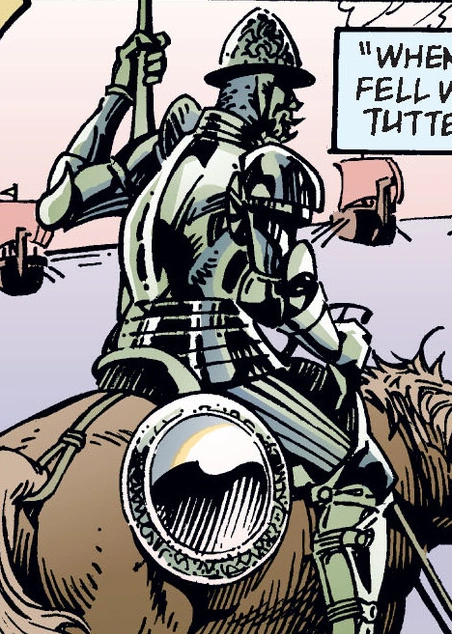 |
Original source
He is based on the titular character of the novel Don Quixote by Miguel de Cervantes. | |

E
The elves
| The elves are Fables who appear in two incarnations: One version first appears in Cinderella: From Fabletown with Love #2 — "Part Two: An Arabian Knight," while a second incarnation of the characters first appear in Everafter: From the Pages of Fables #2 — "Train In Vain: Chapter Two of The Pandora Protocol." |  |
History
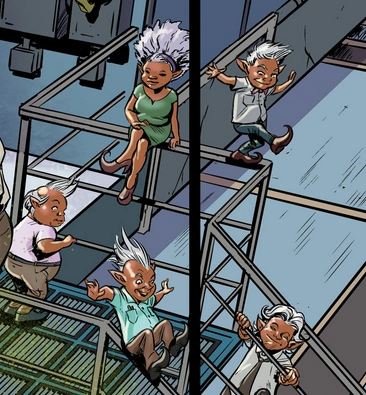 The second incarnation of the elves
| |
Original source
The elves are based on the creatures of the same name from the Brothers Grimm fairy tale of "The Elves and the Shoemaker." | |


Ephram Crow
| Ephram Crow is a Fable who lives in Fabletown in New York City. He first appears in Fables: The Last Castle, where he fought in the battle to defend the last Homelands stronghold against the Adversary. He now works as a security guard at the Knights of Malta Hospital.[15] | 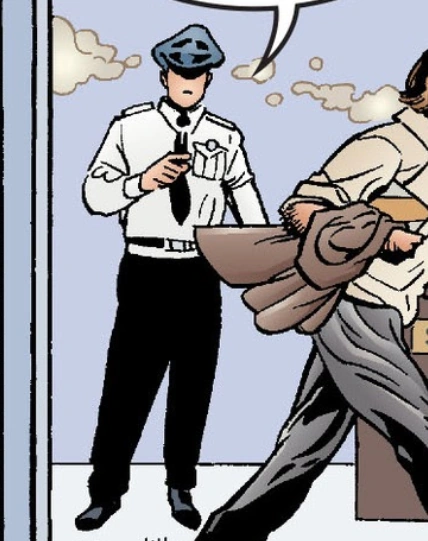 |
Original source
He is based on one of the titular characters of the Brothers Grimm fairy tale of "The Twelve Brothers." | |

Etan Wolf
| Etan Wolf is a Homelands character who appears in Fables #150 — "The Last Snow and Bigby Story." He is a descendant of Bigby Wolf and Snow White. Together with Tannika Wynn, he escorted Rose Red to their family reunion. | 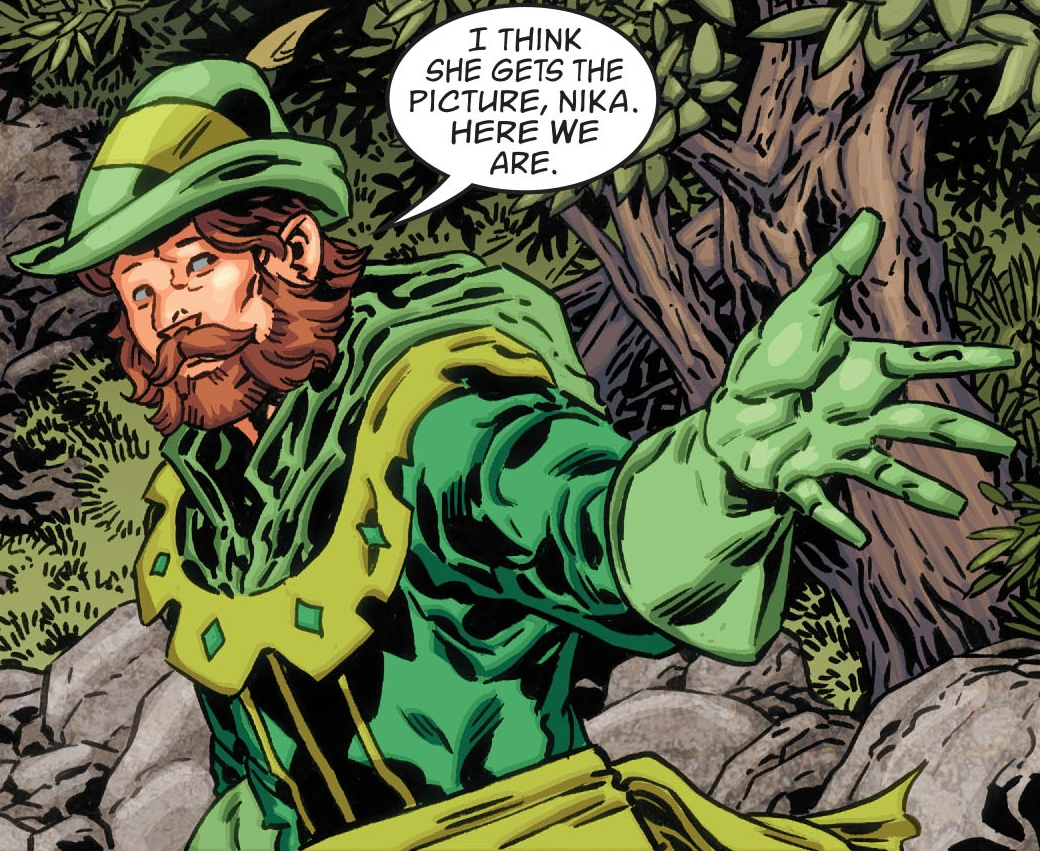 |

F
Fair Katrinelje
| Fair Katrinelje is a Fable who lives in Fabletown and is briefly mentioned in Fables #59 — "Burning Questions," and indirectly in Fairest #30 — "Five Rhymes and a Riddle: Chapter Four of The Clamour for Glamour." She has been dating Vulco Crow when he's human. | |
Original source
She is based on the character of the same name from the Brothers Grimm fairy tale "Fair Katrinelje and Pif-Paf-Poltrie." | |
Fairy Godmother's sisters
| The Fairy Godmother's sisters are Fables who appear in flashbacks from the Homelands in Cinderella: From Fabletown with Love #6 — "Part Six: Ever After." They were Cinderella's Fairy Godmother's sister fairies and were implied to have been poisoned by Frau Totenkinder. | 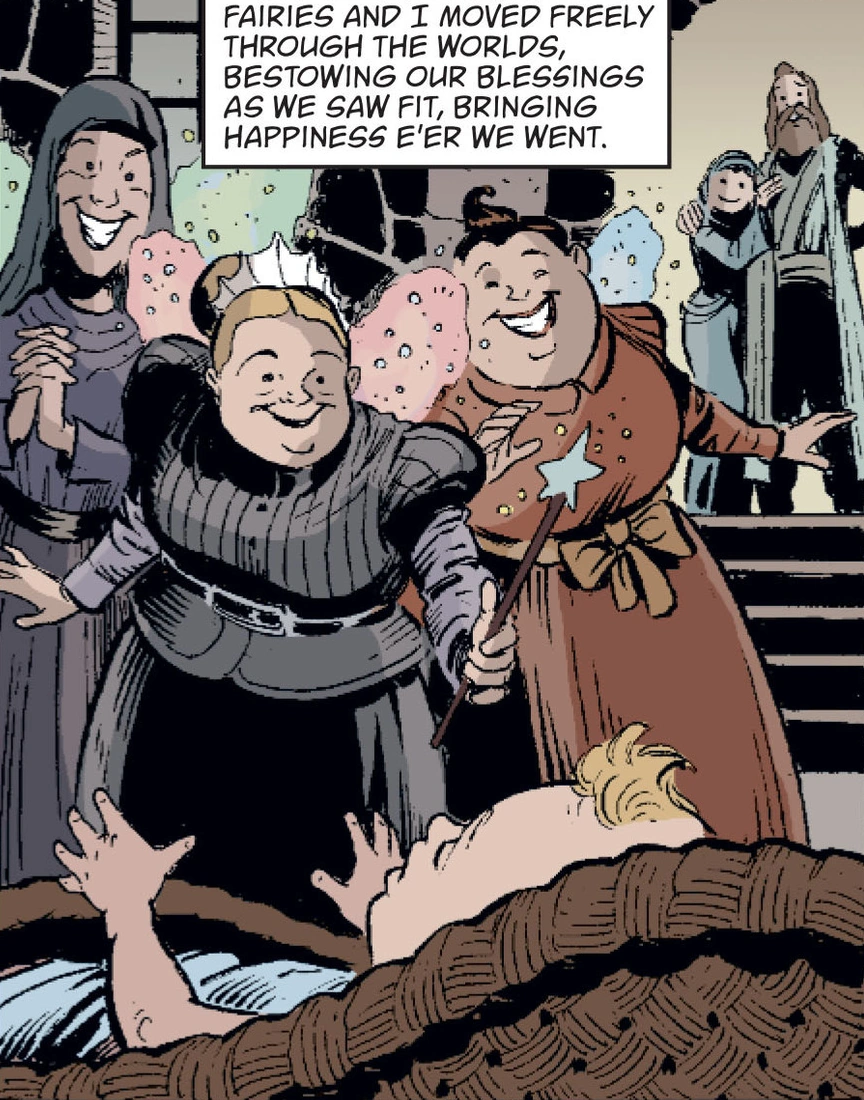 |

Farmer Giles
| Farmer Giles is a Fable who lives at the Farm, and is referred to in Fairest #14 — "Aldered States." He had a one-night stand with Princess Alder. | |
Original source
He is based on the titular character of Farmer Giles of Ham, a comic medieval fable by J. R. R. Tolkien. | |
Fates
| The Fates briefly appear in Fables #123 — "The Destiny Game, Part Two of Two" and Fables #136 — "A Day at the Lake: Part Five of Camelot." The World Turtle suspects that the Lady of the Lake is a personal courtier serving the Fates, ensuring that the essential destinies are conveyed to their rightful owners.[16] | 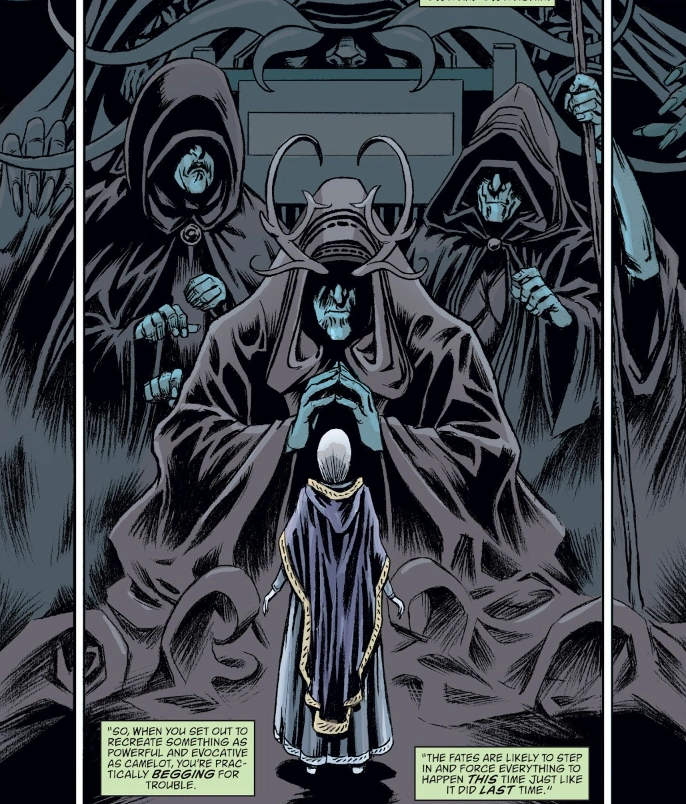 |

Fire dragon
Original source
The fire dragon is based on the dragon from epic poem Beowulf. Unlike in the comic, Beowulf survived the encounter. | ||
The flowers
|
|
 | |
Original source
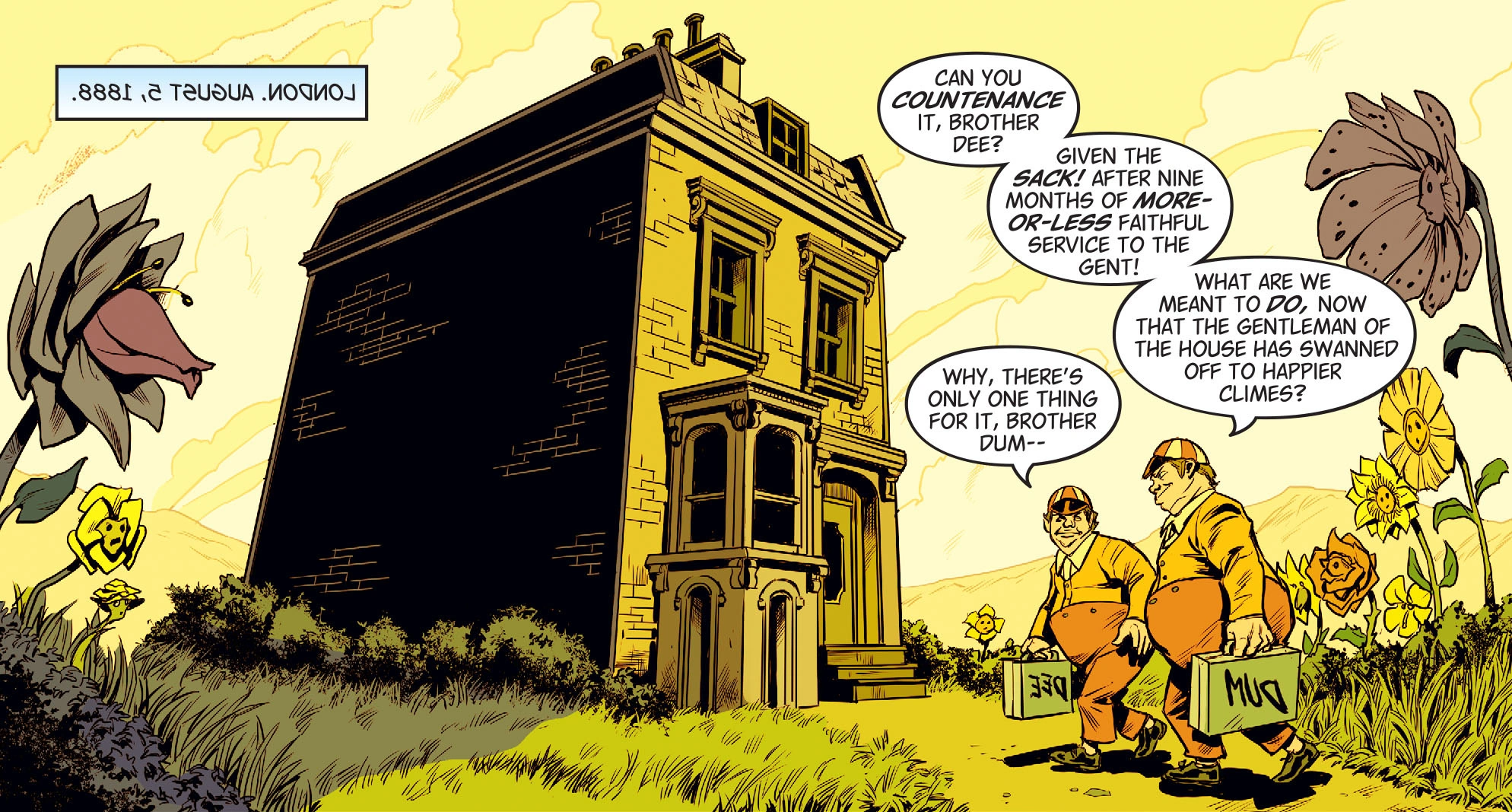
The flowers are based on the characters of the same name from the novel Through the Looking-Glass. The talking flowers that Alice meets in the novel includes the Tiger-lily, the Rose, the Daisy, another Daisy, the Violet, and the Larkspur. Only the Rose and the Tiger-lily appear in the comic; the rest are different species. | ||

Friar Tuck
| Friar Tuck is a Fable who appears in flashbacks from the Homelands in Fables: The Last Castle. He a member of the Miry Men and died alongside Bearskin's Free Company. | 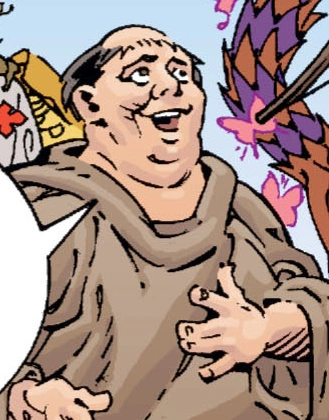 |
Original source
Friar Tuck is based on the character of the same name from the ballads of Robin Hood. | |

G
Gawain
| Gawain is a Fable who briefly appears in a flashback from the Homelands in Fables #62 — "The Good Prince, Chapter Three: Knighthood." | 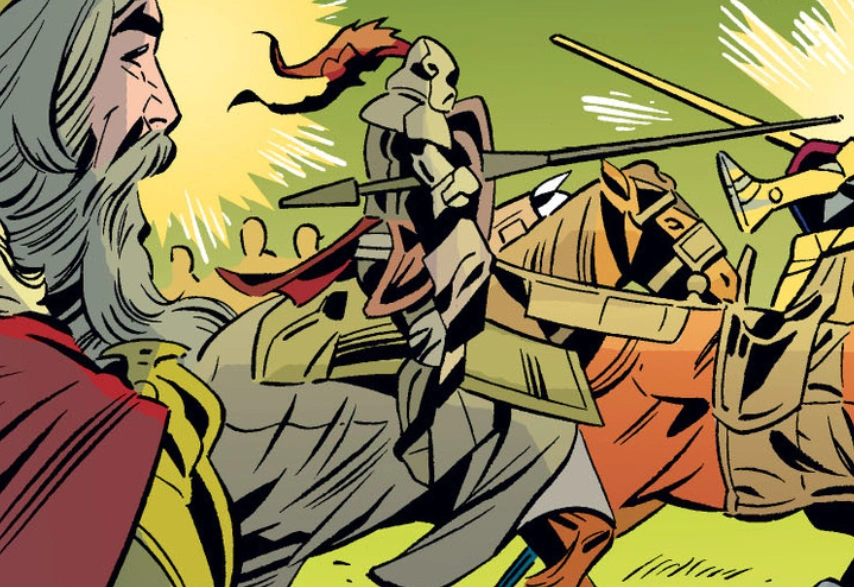 |
History
Gawain was one of the Knights of King Arthur, along with Sir Lancelot. The tales of Lancelot's invincibility in battle were renowned, yet this reputation was ruined when he was defeated by Gawain in a duel. King Arthur suspected that Lancelot had forsaken his moral code, leading to his defeat. | |
Original source
Gawain is based on the character of the same name from Arthurian legend. | |

Glinda
|
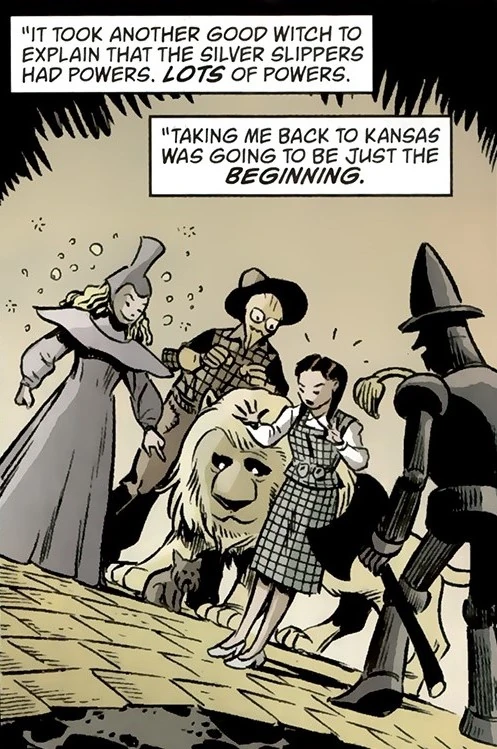
Glinda is a Fable who appears in a brief flashback from Dorothy Gale's adventures in Oz in Cinderella: Fables Are Forever #6 — "Part Six." |
 | |
Original source
Glinda is based on the character of the same name from the children's novel The Wonderful Wizard of Oz, and its many sequels. In the comic, she is merely referred to as a "good witch." | ||
Trivia
In Fables #4 — "Chapter Four: Remembrance Day, there is a brief flashback from the exodus from the Homelands, where an unnamed character is shown flying in a swan-drawn chariot while fleeing the Adversary's forces. In the books, Glinda is said to ride a fancy chariot driven by swans or storks; however, while the figure appears to be a woman, a closer inspection reveals that the person is wearing a hood, and what appears to be a mane of long flowing hair is actually part of the chariot. Annotations in the Fables Encyclopedia speculate that this may be Apollo.[14] | ||

Good Witch of the North
|
|
 | |
Original source
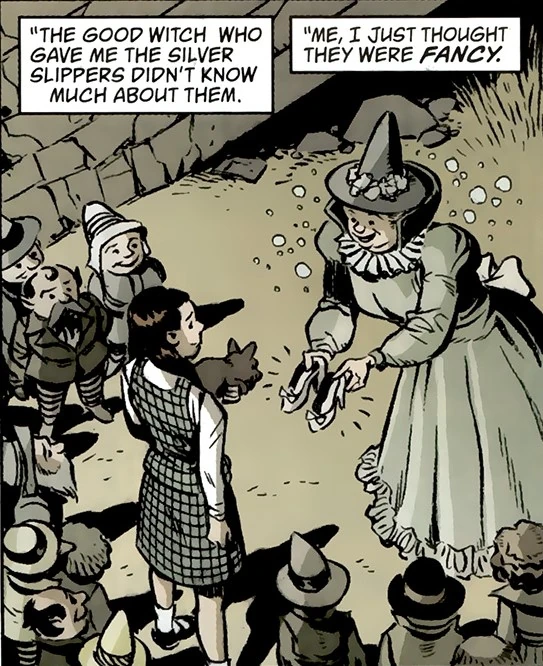
She is based on the Good Witch of the North from the children's novel The Wonderful Wizard of Oz, and its many sequels. In the comic, she is merely referred to as "the Good Witch." | ||
.jpg)
Grendel (Gotham)
Grendel is an infamous Fable monster who is mentioned in Batman vs. Bigby! A Wolf in Gotham #6 — "Chapter Six: Wild Animals." He is the son of the third incarnation of his equally infamous mother. |
||
Original source
Grendel is based on the character of the same name from the epic poem Beowulf. He is a monstrous being defeated by the titular character. Condemned to wander the earth, Grendel is an outcast who traces his ancestry back to the biblical Cain. He takes revenge on humans by causing terror and sometimes feasting on the warriors of the Danish king Hrothgar. Beowulf, a warrior and leader of the Geats, a tribe hailing from Sweden, faces him in battle and fatally wounds him. Grendel's horrible mother seeks revenge for her son's demise, only to be vanquished and slain by Beowulf too.[18] | ||
Greyheart
| Greyheart[19] is one of the seven sons of North Wind and Winter, and brother to the infamous Bigby Wolf.[20] He first appears in Fables: 1001 Nights of Snowfall — "The Runt." | 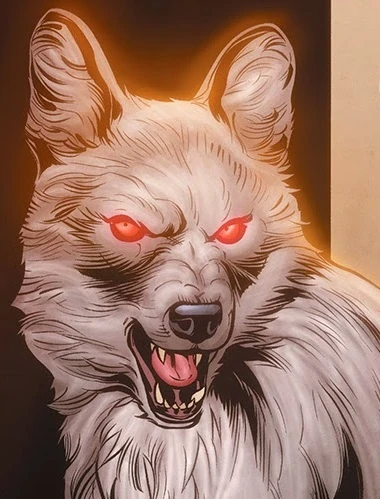 |

Grimauld
| Sir Grimauld is a Fable who briefly appears in a flashback from the Homelands in Fables #62 — "The Good Prince, Chapter Three: Knighthood." He became a Knight of the Round Table after Sir Lancelot beat him in a duel. | 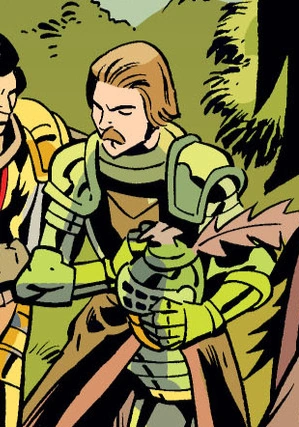 |
Original source
Based on the color of his armor, Sir Grimauld may be the Green Knight from Arthurian legend, more specifically the poem Sir Gawain and the Green Knight[21] | |

Gudrun
| Gudrun, also known as the goose that lays the golden eggs, and the golden goose, is a Fable who secretly lives in the basement of Fabletown's Woodland building. She appears in Fables #31 — "The Long, Hard Fall," and is mentioned in Fables #88 — "Totenkinder: Chapter Two of Witches." Believed killed in the Adversary's assault on the Homelands, Gudrun actually escaped and now lives in a secret den within The Woodland building. Her eggs provide Bigby with an untraceable source of funds for his covert activities. With Bigby moves on, Gudrun now fulfills the same role for his replacement, Beast. | 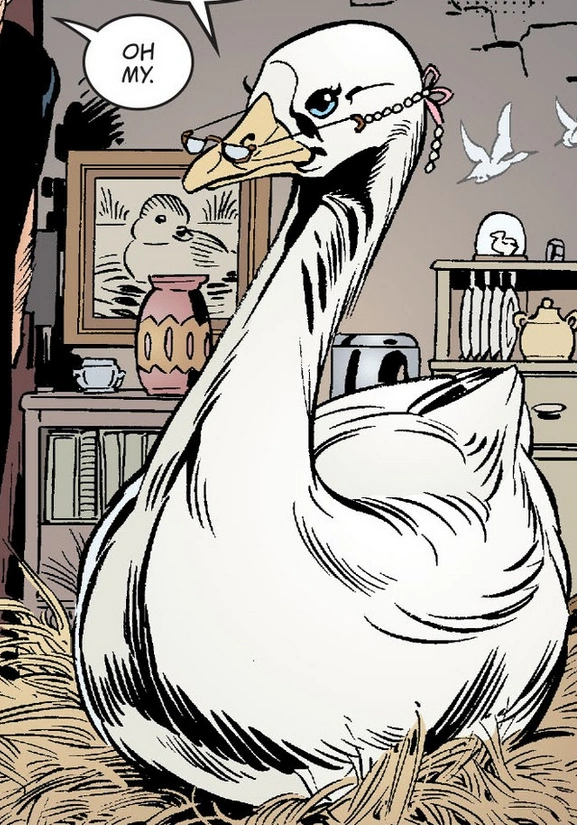 |
Original source
| |

Guinevere
| Guinevere is a human Fable who briefly appears in a flashback from the Homelands in Fables #62 — "The Good Prince, Chapter Three: Knighthood." Lancelot, Camelot's most accomplished warrior, had been given a blessing by an elderly woman. She told him that he would be unbeatable in battle as long as he remained pure and honorable. Lancelot claimed many victories until his honor was shattered when he made the mistake of having a love affair with Guinevere, King Arthur's beloved wife. | 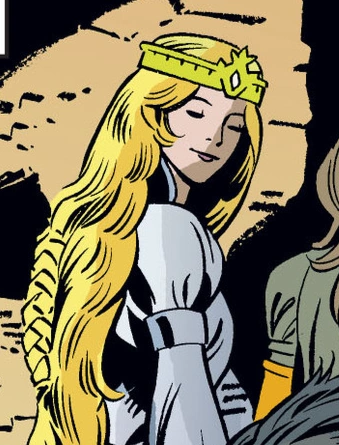 |
Original source
She is based on the character of the same name from Arthurian legend. | |

Gwen (comic series)
Gwen is an unseen Fable who works at the Pudding & Pie,[24] a strip club run by Georgie Porgie, located on a part of Fabletown known as the Crooked Mile, in New York City's Meatpacking District.[25] She is briefly mentioned by Vivian in Fables: The Wolf Among Us #42 — "Chapter Forty-Two." |
||
H
Halldis
| Halldis is a Homelands character whose first appearance was in Fables #147 — "The Peaceable Kingdom: Chapter Seven of Happily Ever After." She is an elder sister to Lauda. | 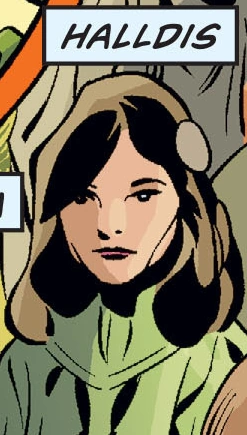 |

Hallerna
| Hallerna is a Homelands character whose first appearance was in Fables #147 — "The Peaceable Kingdom: Chapter Seven of Happily Ever After." She is an elder sister to Lauda. | 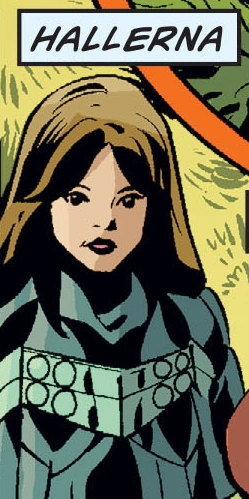 |

Headless Horseman (comic series)
|
 | |
Original source
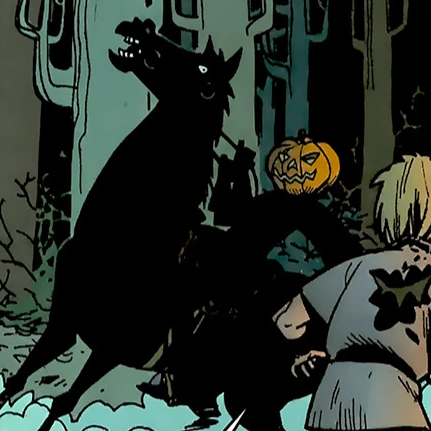
He is based on the Headless Horseman from Washington Irving's short story "The Legend of Sleepy Hollow," himself based on a character[26] that can be found in various forms throughout European folklore, and northern Indian lore.[27] In Irving's story, the Headless Horseman is depicted with a pumpkin for a head, much like he is in the comic. Another version of the Headless Horseman is the Dullahan from Irish mythology, a demonic entity depicted riding a horse and carrying his head.[26] | ||
Trivia
The statuette used by Bigby to bludgeon Ichabod Crane's head in Fables #22 — "Cinderella Libertine" is a headless sculpture of Napoleon Bonaparte, drawing a parallel to the iconic Headless Horseman. In the next panel, a pumpkin is being smashed by a passing car, a clear nod to the infamous Horseman's head pumpkin described in the story. During the video game The Wolf Among Us, players can come across the same statuette in Crane's apartment during the episode "A Crooked Mile." This will unlock an entry about the Headless Horseman in the game's Book of Fables. According to the entry, the figure is a depiction of the Horseman. To be precise, both sculptures are modeled after the famous 1801 oil painting Napoleon Crossing the Alps, created by renowned French artist Jacques-Louis David.[28] | ||

Hel
| Hel is a Fable deity who briefly appears in the Homelands in the chapter story Fables #150 — "The Last Snow and Bigby Story." She is a descendant of Bigby Wolf and Snow White. | 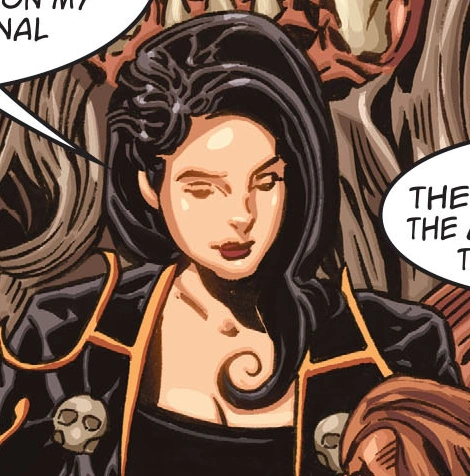 |
Original source
Hel is based on the character of the same name from Norse mythology. | |

Hrotgar
| Hrotgar is a Fable who was one of Grendel's neighbors in the Homelands. He is mentioned in Fables #124 — "A Revolution in Oz, Chapter Eleven: Emperor Bufkin" and Fables: The Wolf Among Us #11 — "Chapter Eleven." | |
Huckleberry Finn
|
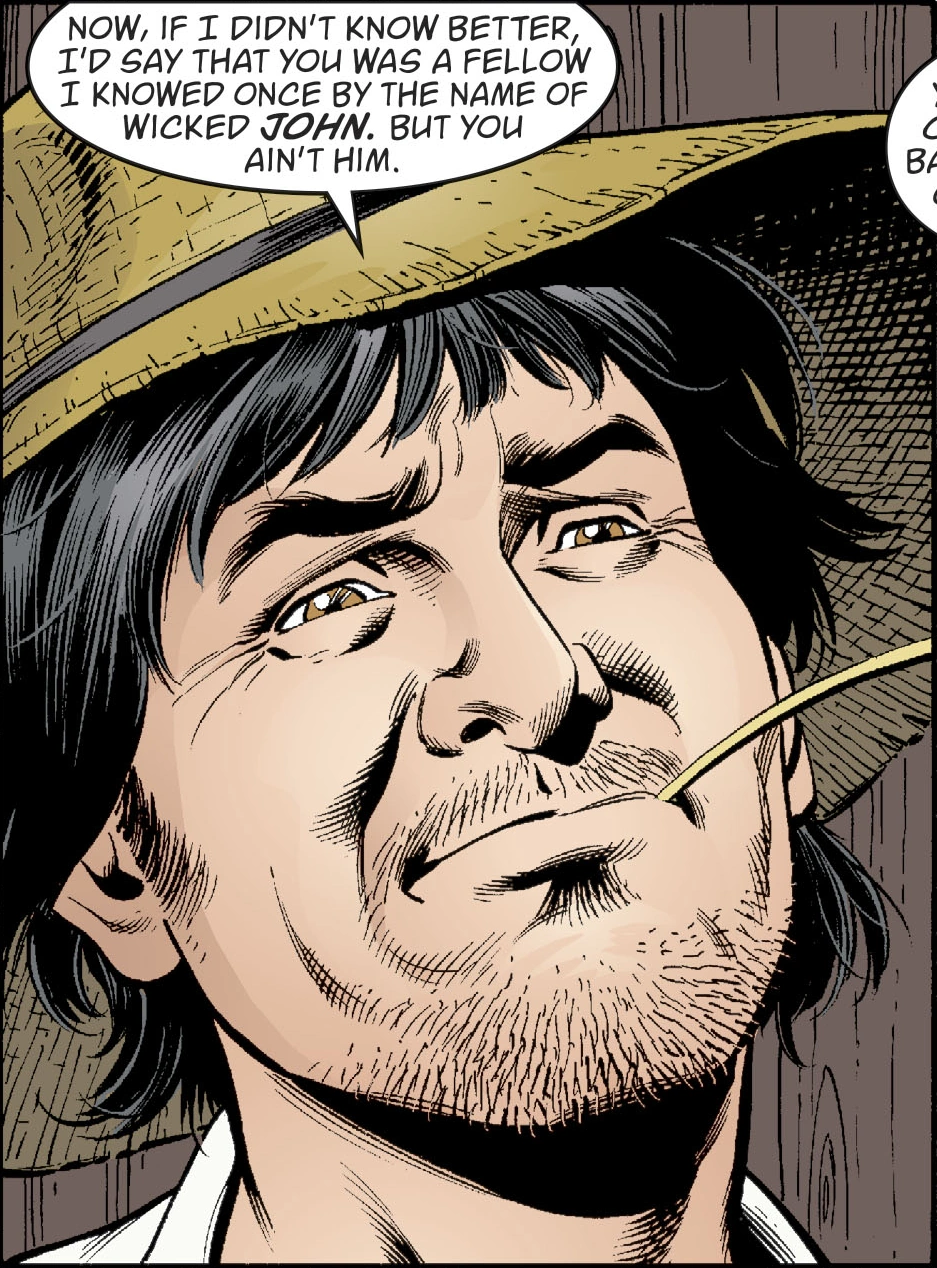
Huckleberry Finn is a human Fable from Americana, who appears alongside his friend Jim in Jack of Fables #17 — "Americana, Part 1: On Eggshells" and Jack of Fables #18 — "Americana, Part 2: Welcome to Americana — Mind the Zombies." |
 | |
Original source
Huckleberry Finn is based on the character of the same name from the novel The Adventures of Tom Sawyer and its sequels. | ||

The huntsman
 | ||
History
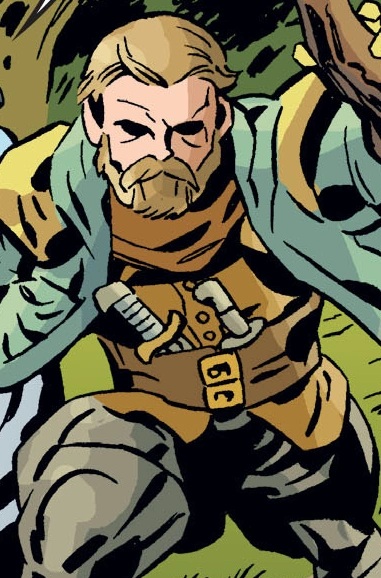
The huntsman appears in flashbacks during the "Rose Red" and "Camelot" story arcs, playing the same role as he does in the fairy tale. In the Fairest story arc "Of Men and Mice," it is established that he is a resident of Fabletown. It is implied that he and Crispin are close friends; when Crispin is in a coma after a bomb attack meant for Cinderella, the huntsman remains at Crispin's bedside for days. | ||
Original source
The huntsman is based on the character of the same name from the "Snow White" fairy tale. | ||

I
Incitatus
| Incitatus, nicknamed Tate,[29] is a Fable who resides at the Farm. He appears in Jack of Fables #22 — "1883, Chapter One: The Legend of Smilin' Jack," Jack of Fables #23 — "1883, Chapter Two: Moon of the Wolf" and Jack of Fables #24 — "1883, Chapter Three: The Showdown." He is an anthropomorphic horse who was once a senator in the Homelands version of Rome.[30] Eager to get some time away from the Farm, he assists Bigby in tracking down Jack Horner during a flashback sequence set in the Old West.[31] He talks so much that he risks giving away his status as a Fable, and frequently mentions his former status as a Roman senator.[29][30] | 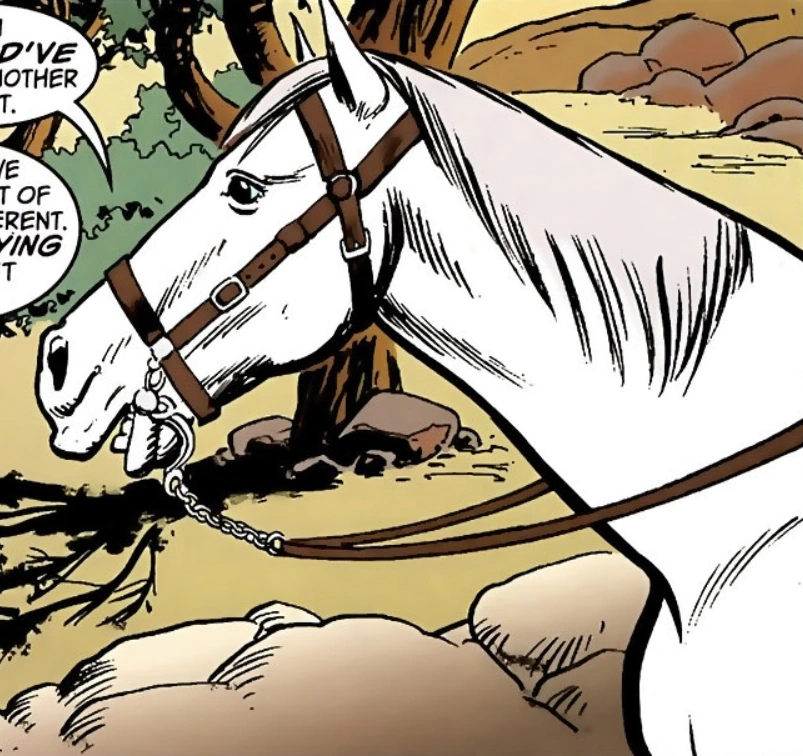 |

Ísond
| Ísond is a Homelands character whose first appearance was in Fables #147 — "The Peaceable Kingdom: Chapter Seven of Happily Ever After." She was an elder sister to Lauda. | 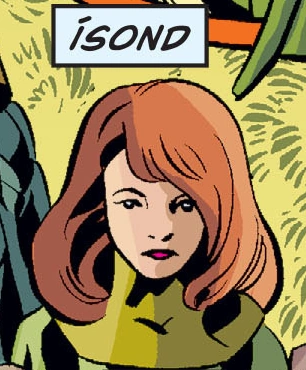 |

J
Jabberwock
| The Jabberwock is a Fable creature mentioned in Fables #36 — "Death & Taxes: Chapter One of Homelands." Much like in the source material, it was felled by the Vorpal Blade. | |
Original source
The Jabberwock is based on the character of the same name from the nonsense poem "Jabberwocky" from the novel Through the Looking-Glass. | |
Jack Ketch
| Jack Ketch is a human Fable who, according to Fables #60 — "The Good Prince, Chapter One: Flycatcher," appears to live in Fabletown in New York City. He appears in Fables #10 — "Twilight of the Dogs: Part Five of Animal Farm" and is mentioned in Fables: 1001 Nights of Snowfall — "The Fencing Lessons" and Fables #60 — "The Good Prince, Chapter One: Flycatcher." In the Homelands, he held the position of royal executioner for Prince Charming's family. After the revolution at the Farm is put down, Jack performs the task of executing Posey and Dun for their role as ringleaders of the event. | 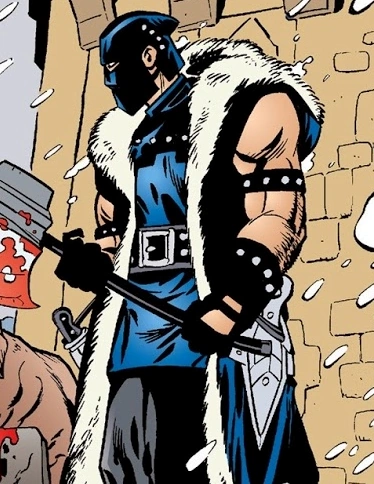 |
Original source
Jack Ketch is one of the few Fables in the series to be based on a real person, rather than a purely fictional character. In reality, Jack Ketch was an infamous executioner working for King Charles II of England in the late 1600s. | |

Jenny Wren
| Jenny Wren is a Fable who lives at the Farm, and first appears in Cinderella: Fables Are Forever #1 — "Part One." She works for Cinderella as one of her animal spies. She hopes to find those who murdered her lost love Robin Redbreast during the Adversary's invasion of her homeland and take revenge. | 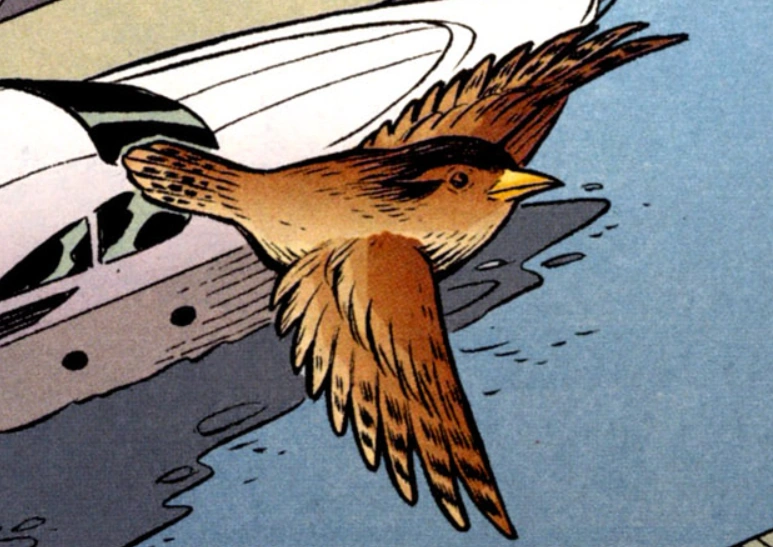 |
Original source
Jenny Wren is based on the character of the same name from a cycle of nursery rhymes,[32] such as "Cock Robin Got Up Early," "Little Jenny Wren Fell Sick," and "The Wedding of Robin Redbreast and Jenny Wren." | |

Jill (the original)
Jill is a Fable mentioned in Fables #59 — "Burning Questions," where Jack calls her on a payphone before leaving Fabletown for Hollywood. According to Jack, she is "the original Jill" in his life. |
||
Original source
Jill is based on one of the titular characters of the nursery rhyme "Jack and Jill." | ||
Jim
| Jim is a human Fable from Americana, who appears alongside his friend Huckleberry Finn in Jack of Fables #17 — "Americana, Part 1: On Eggshells" and Jack of Fables #18 — "Americana, Part 2: Welcome to Americana — Mind the Zombies." | 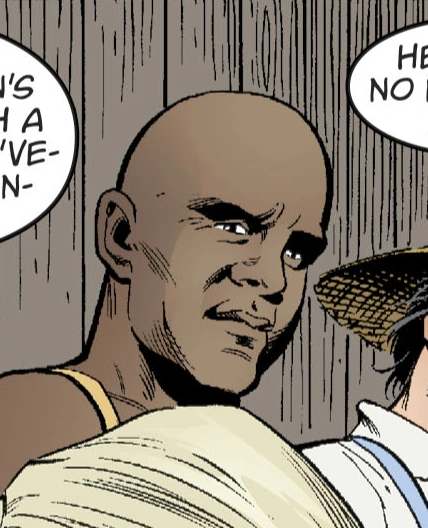 |
Original source
Jim is based on the character of the same name from the novel The Adventures of Tom Sawyer. | |

John Henry
| John Henry is a Fable imprisoned at the Golden Boughs Retirement Village. He first appears in Jack of Fables #6 — "Jack Frost, Part One of Two." John Henry managed to escape with Alice and Pecos Bill during the big breakout from the Golden Boughs. The group briefly accompanied Jack Horner, who entertained them with the story behind his identity as Jack Frost. | 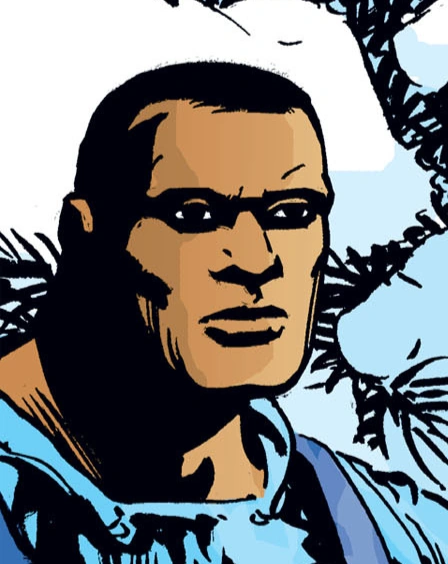 |
Original source
He is based on the American legend of John Henry. | |

John Small
| John Small is a Fable who briefly appears in flashbacks from the Homelands in Fables: The Last Castle. John Small was a member of the Miry Men (the Fables version of the Merry Men) and died alongside Bearskin's Free Company, defending the last gateway to the mundane world. | 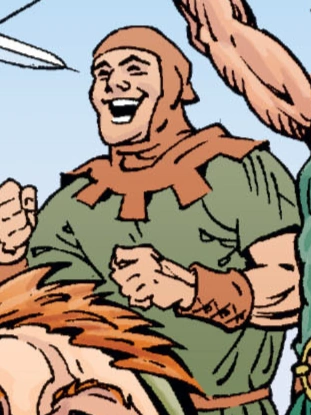 |
Original source
John Small is based on Little John from the ballads of "Robin Hood." | |

John the Presbyter
| John the Presbyter is a human Fable who first appears briefly via memory in Fables #62 — "The Good Prince, Chapter Three: Knighthood." In the story, the ghost of Sir Lancelot knights Ambrose and endows him with the privilege to carry arms and dispense justice, "by the blood of every true king." Among those kings, he references "John the Presbyter in his lost kingdom." John the Presbyter appears in the background via memory, accompanied by the Great Lion and King Arthur. John the Presbyter once again appears via memory in Fables #150 — "Farewell,", alongside the Great Lion and King Arthur, as King Ambrose proclaims that the King and his law are one, and sentences Prince Brandish to death. | 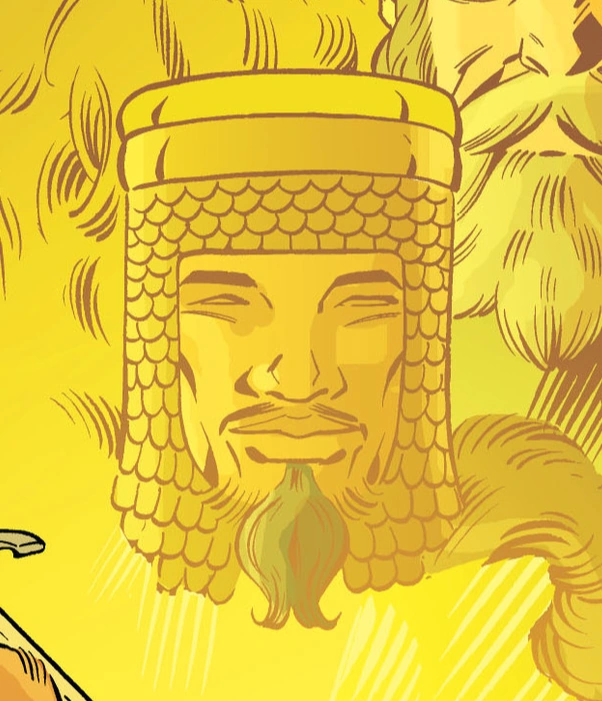 |
Original source
He is based on the legend of Prester John, also known as John the Elder and Presbyter John. Prester John was a mythical Christian ruler of the East, celebrated in medieval chronicles and traditions as a sought-after ally in the fight against Muslim forces. He was a purported king-priest reigning "in the Far East beyond Persia and Armenia." Numerous legends revolve around Prester John, which can be traced back to the writings attributed to "John the Elder" in the New Testament.[33] | |

K
Karynderon
| Karynderon is a Homelands character who appears in flashbacks in the issue Fables #97 — "Dark Age Party Girl, Chapter Four of Rose Red." It was a dragon who dwelled in the mountains north of Prince Charming's lands. Although Charming had a peace treaty with Karynderon, Rose Red undid this by sending a brotherhood of knights to slay it in her name. | 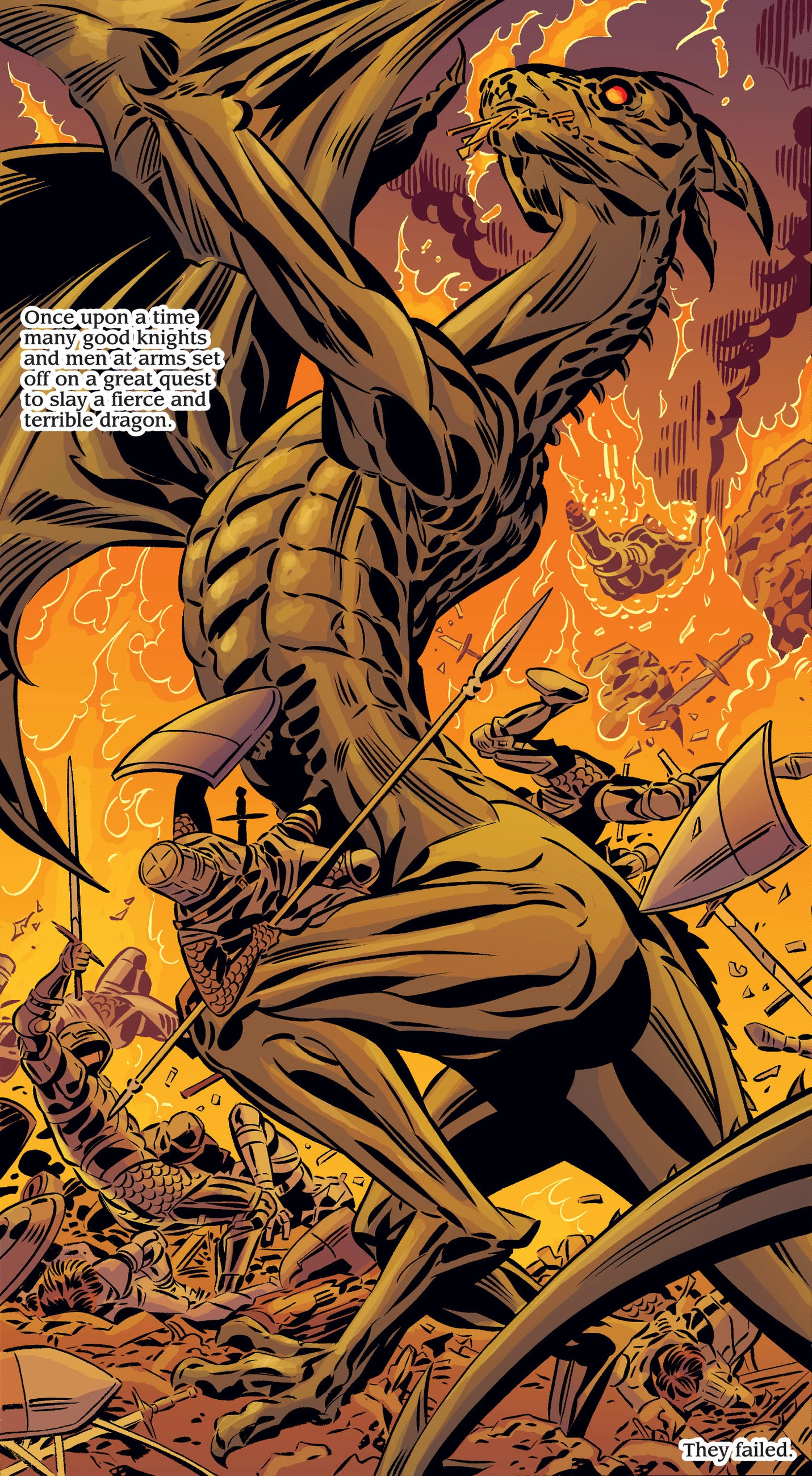 |

Káta
| Káta is a Homelands character whose first appearance was in Fables #147 — "The Peaceable Kingdom: Chapter Seven of Happily Ever After." She was an elder sister to Lauda. | 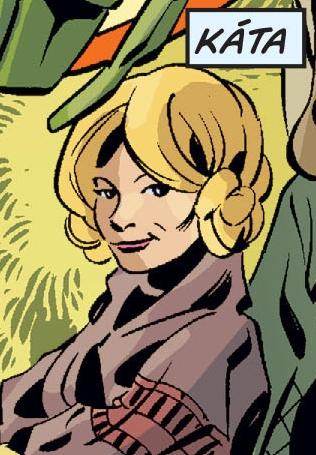 |

Kesa
| Kesa is a Homelands character who appears in flashbacks in Jack of Fables #6 — "Jack Frost, Part One of Two" and Jack of Fables #11 — "Jack Frost, Part Two (of Two)." She is one of the Lumi's three sisters and aunt to her son, Jack Frost. Kesa is the Summer Queen and summer will reign where she dwells. | 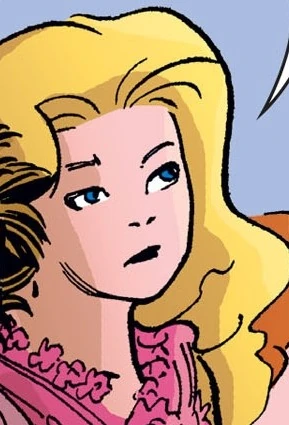 |

Kevat
| Kevat is a Homelands character who appears in flashbacks in Jack of Fables #6 — "Jack Frost, Part One of Two" and Jack of Fables #11 — "Jack Frost, Part Two (of Two)." She is one of Lumi's three sisters and aunt to her son, Jack Frost. Kevat is the Spring Queen, and she brings April showers and May flowers wherever she stays. | 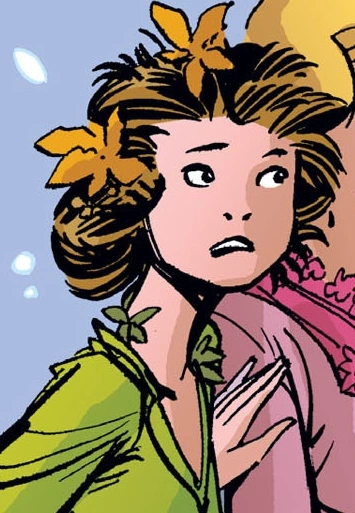 |

King Edward's wife
| King Edward's wife is a Fable who appears in flashbacks from the Homelands in Fables: The Wolf Among Us #5 — "Chapter Five." |  |
Original source
She is based on the King's wife from the fairy tale "Donkeyskin" by Charles Perrault. | |

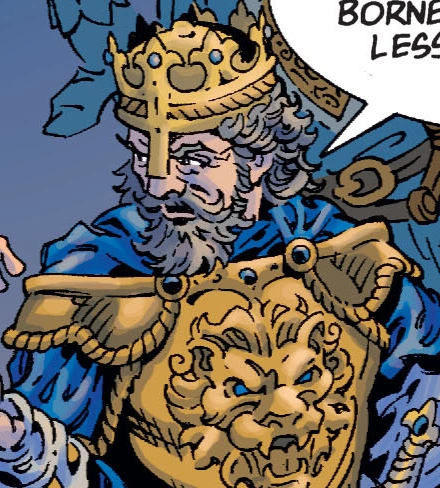
King of Bornegascar
 | ||
Original source
He is based on the character of the same name from the story "Two Kings" in the short story collection Fantastic Fables by Ambrose Bierce. | ||

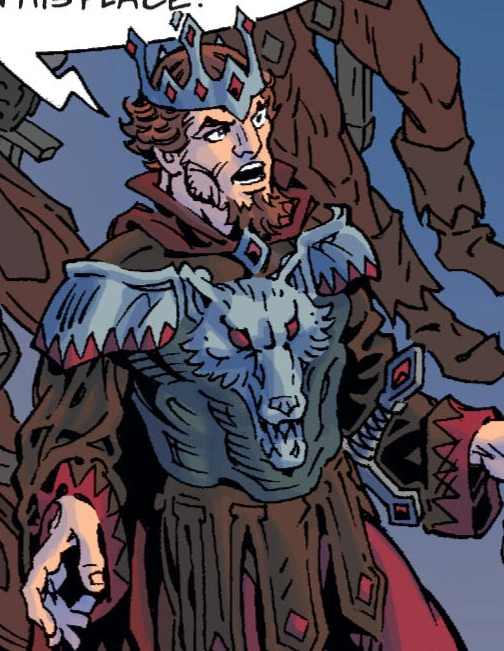
King of Madagao
 | ||
Original source
He is based on the character of the same name from the story "Two Kings" in the short story collection Fantastic Fables by Ambrose Bierce. | ||

King Pellinore
| King Pellinore is a Fable who appears in flashbacks from the Homelands in Fables: The Last Castle. The ancient King Pellinore's rusty armor kept trying to fall apart during his weeks defending the gateway to the keep at world's end, where the last Fable refugees escaped from to the Mundy world. His squire had to follow him around, retrieving the pieces that were dropped off in his way. | 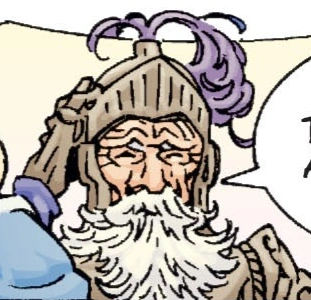 |
Original source
| |

Kolbrún
| Kolbrún is a Homelands character whose first appearance was in Fables #147 — "The Peaceable Kingdom: Chapter Seven of Happily Ever After." She was an elder sister to Lauda. | 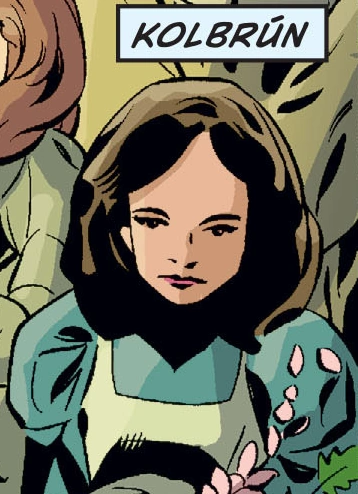 |

L
La Llorona's husband
|
|
 | |
Original source
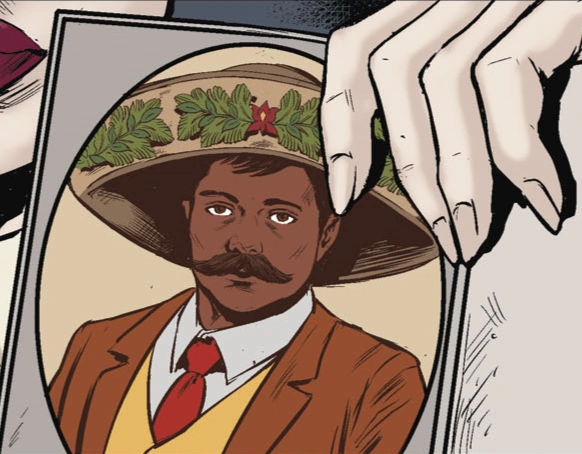
He is based on the character of the same name from the ghost story of La Llorona from Mexican folklore. | ||

Lauda's husband
 | ||

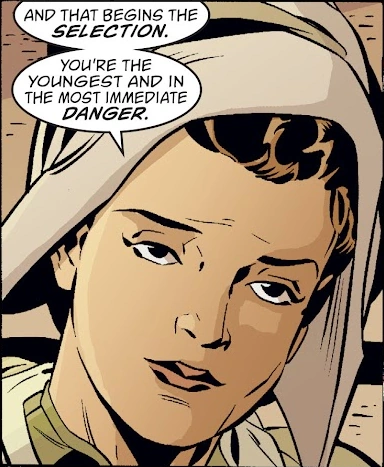
Lauda's mother
 | ||

Lif
| Lif is a Homelands character who first appears in Fables #147 — "The Peaceable Kingdom: Chapter Seven of Happily Ever After." She was an elder sister to Lauda. | 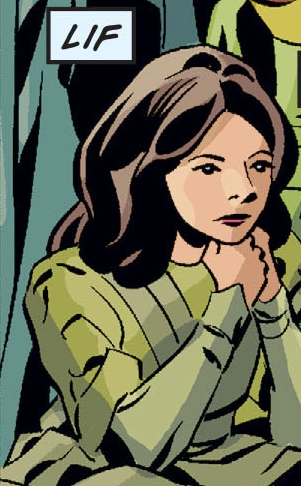 |

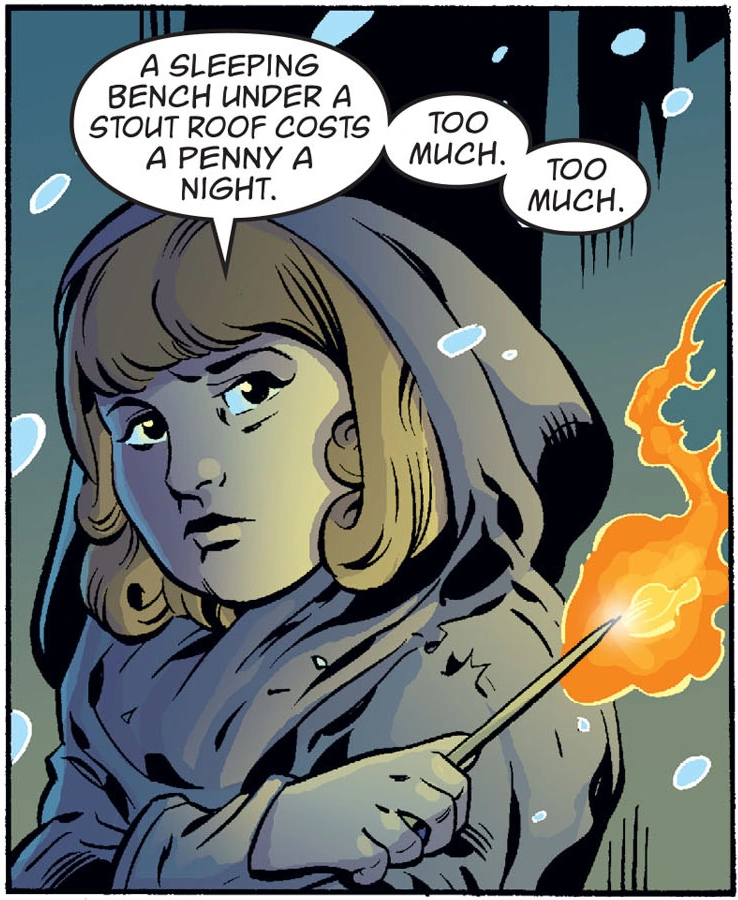
The little match girl
|
|
 | |
History
The girl appears to Rose Red as one of the paladins of Hope, ostensibly on the night that the girl is doomed to die (Christmas Eve, in this telling). The child identifies herself as "the caretaker of hope deferred," braving the deadly cold and saving the meager pennies she earns towards the promise of a better life in the future, and stubbornly denying that her death is close at hand. Rose is heartbroken, because she knows that the girl will freeze to death, with all her hopes unfulfilled. | ||
Original source
She is based on the titular character of Hans Christian Andersen's fairy tale "The Little Match Girl." | ||

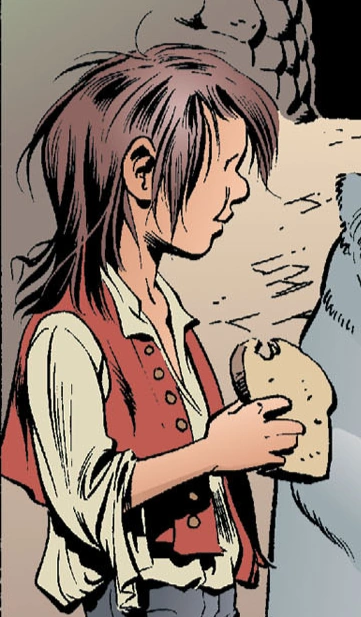
Little Tommy Tucker
|
|
 | |
Original source
He is based on the titular character of the nursery rhyme "Little Tommy Tucker." | ||

Lost Boys
|
|
||
Lúta
| Lúta is a Homelands character whose first appearance was in Fables #147 — "The Peaceable Kingdom: Chapter Seven of Happily Ever After." She is an elder sister to Lauda. | 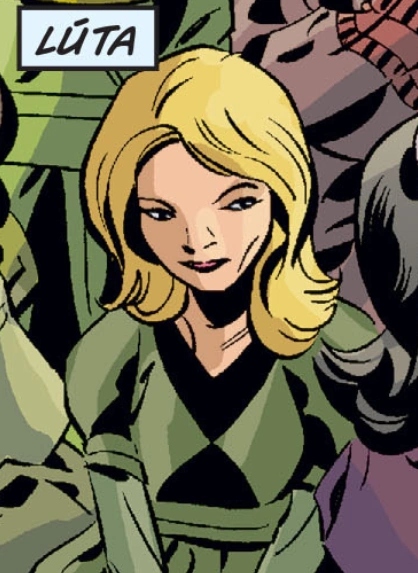 |

M
The man, the seven wives and the cats
|
|
 | |
History
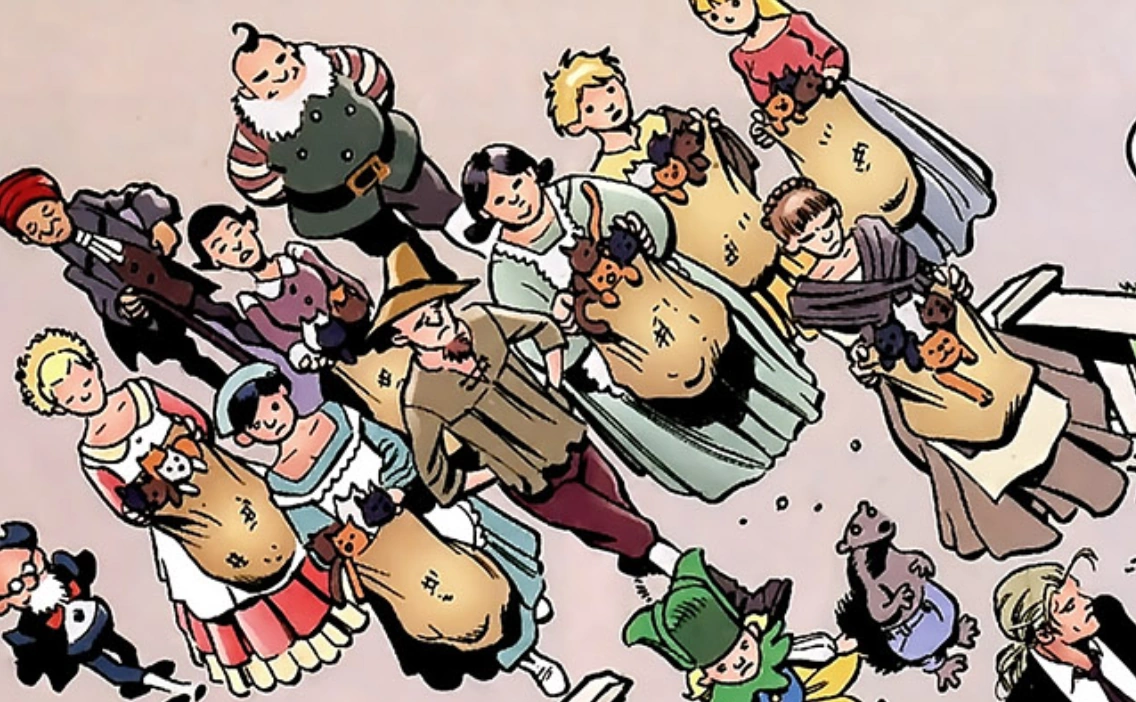
During their first appearance, the cats escape from the sacks, and Gary the Pathetic Fallacy animates the sacks to go catch them again. In Jack of Fables #4 — "Jackrabbit," some members of the family can be seen escaping the Golden Boughs during the mass breakout. | ||
Original source
They are based on the characters from the nursery rhyme "As I was going to St Ives." | ||

Marian
| Marian, also known as Maid Marian,[38] is a human Fable who briefly appears in flashbacks from the Homelands during Fables #4 — "Chapter Four: Remembrance Day," where she can be seen among a large group of Fables fleeing the Adversary's forces. As mentioned in the one-shot Fables: The Last Castle, she was in a relationship with Robin Loxley, and was killed when the invaders took his homeland. | 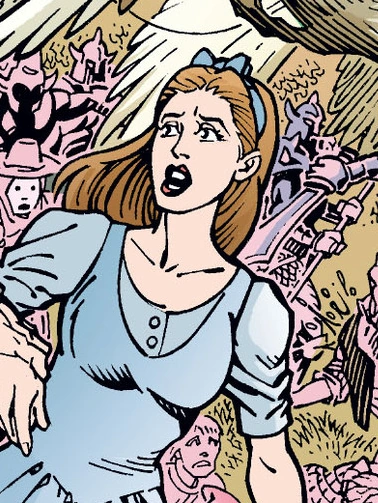 |
Original source
Marian is based on Maid Marian from the ballads of Robin Hood. | |

Minotaur
|
|
 | |
Original source
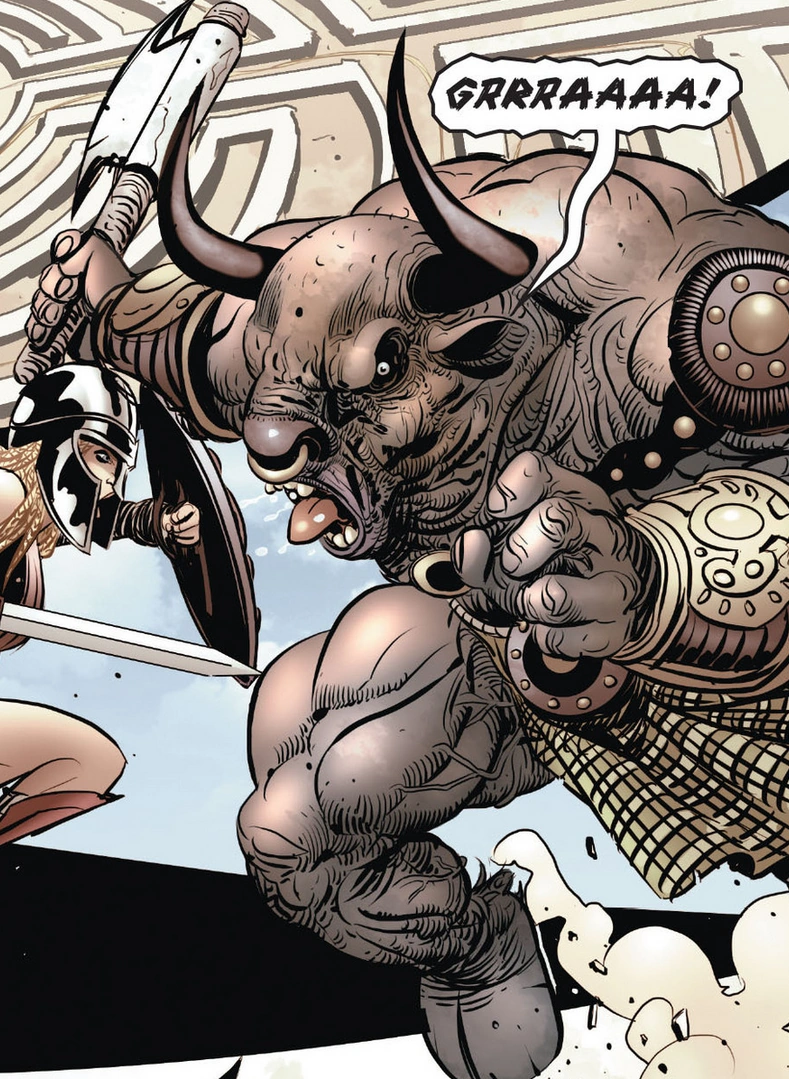
The Minotaur is based on the mythical creature from Greek mythology. | ||

Miry Men
| The Miry Men appear in a flashback from the Homelands in Fables: The Last Castle. Members of the group includes Robin o' the Woods, Friar Tuck and John Small. | 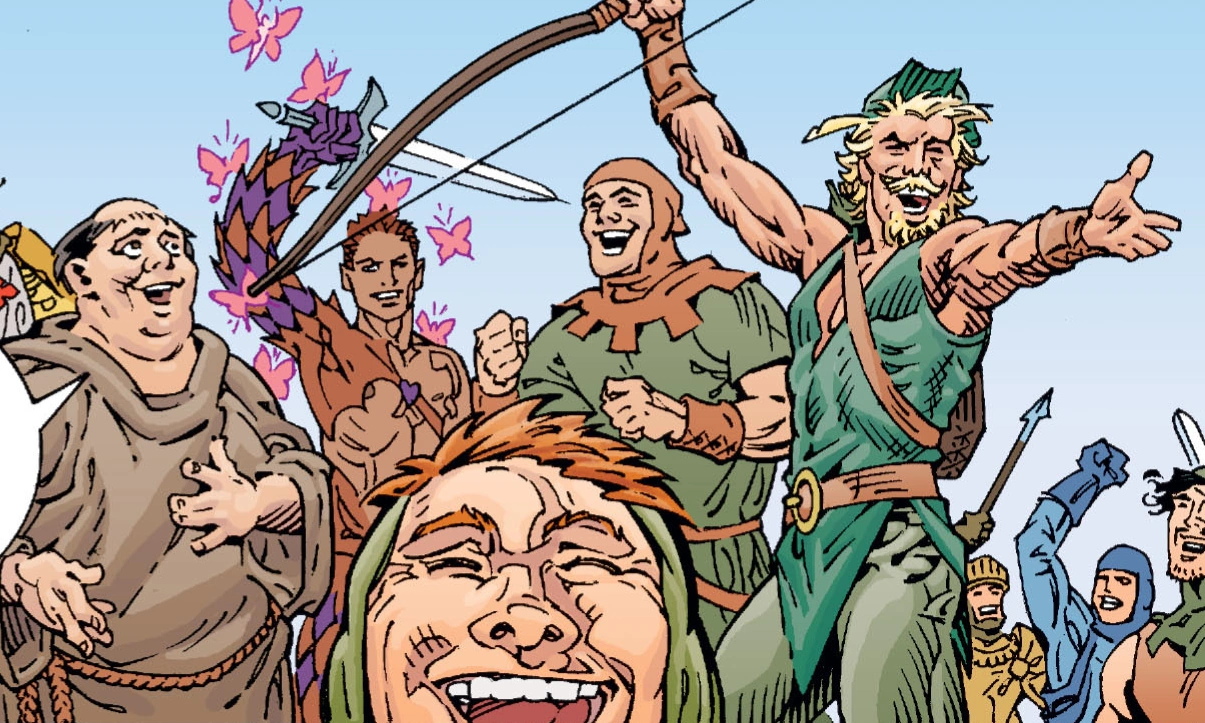 |
Original source
They are based on the Merry Men from the ballads of Robin Hood. | |

Miss Mousey
| Miss Mousey is a Fable who lives at the Farm. She is mentioned in Fables #24 — "The Letter: Chapter Five of March of the Wooden Soldiers" | |
History
In Fables #24 — "The Letter: Chapter Five of March of the Wooden Soldiers," Mustard Pot Pete can be seen writing down the mouse's complaints; the text says, "Miss Mousey complained about the frogs again." In addition, Ambrose is singing the song in Fables #2 — "Chapter Two: The (Un)Usual Suspects," as does one of the Three Blind Mice in Fables #100 — "Single Combat." | |
Original source
Miss Mousey is based on the character of the same name from the folk song "Frog Went a-Courting." | |
Miss Silkytail
| Miss Silkytail is a Fable hare who resides at the Farm and briefly appears in Fables: 1001 Nights of Snowfall — "A Mother's Love." Colonel Thunderfoot tried, unsuccessfully, to woo her. | 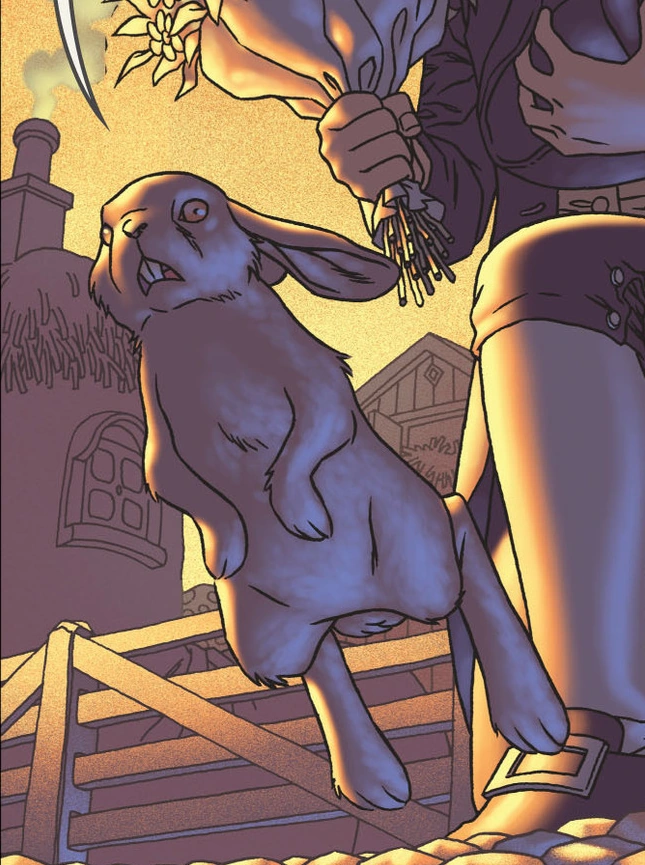 |

Missy Skunk
| Missy Skunk is an animal Fable mentioned in Fables #24 — "The Letter: Chapter Five of March of the Wooden Soldiers" and Fables #125 — "Riding in Cars with Gods: Chapter One of Snow White." | |
History
The badger "Stinky" was bequeathed with his nickname after an encounter with Missy Skunk. According to Stinky, he fell down her hole once, which shouldn't be enough to warrant such a disreputable nickname. Rose Red labels the encounter as an interspecies romance, but Stinky claims there was no romance because she was a skunk.[39] However, he later reveals to Bigby Wolf that he actually doesn't mind the sobriquet. He confesses that his tumble into Missy Skunk's den was not an accident: In a drunken stupor, he found her alluring and she used her charm to seduce him.[40] | |
Mistral
| Mistral is a Fable from the Homelands, who debuts in Fables #32 — "The Dark, Killing Winter." He is one of the winds who serve the North Wind. | 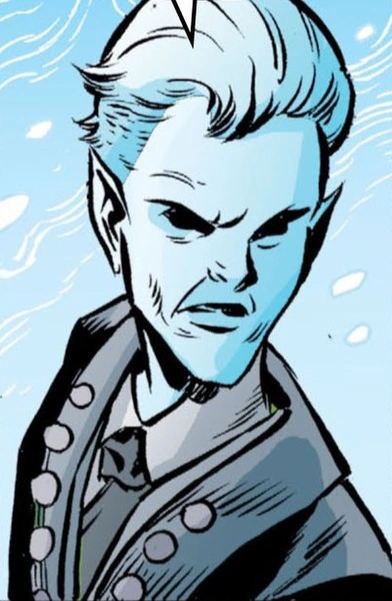 |

Monkey-Faced Boy
| The Monkey-Faced Boy first appears in Everafter: From the Pages of Fables #1 — "The Show Me State: Chapter One of The Pandora Protocol." He was originally a kid named William Lemp who lived in a haunted mansion, and is one of the many figures from St. Louis folklore that Jordan Yow raised from the collective unconscious.[7] | 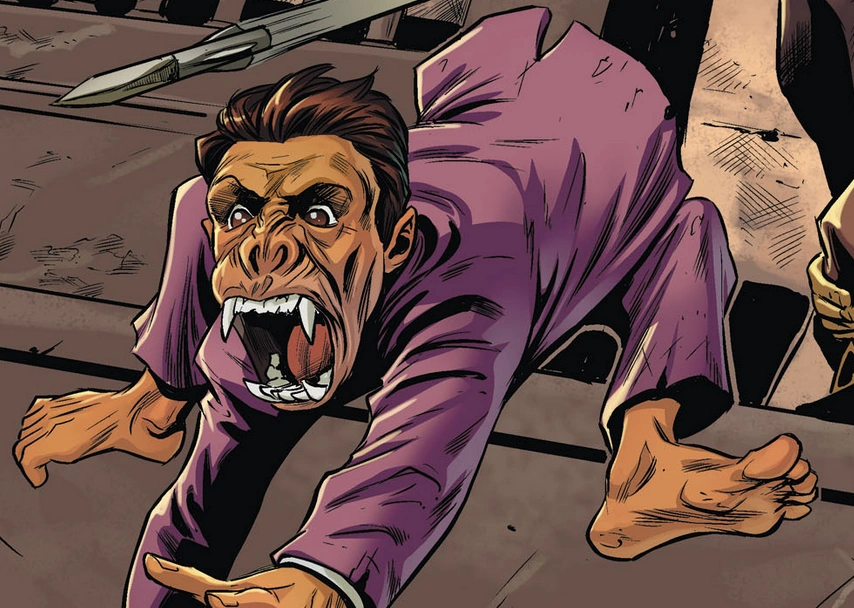 |
Original source
He is based on the Monkey Face Boy, a child said to haunt a mansion in St. Louis.[41] | |

Morgiana
| Morgiana is a Fable mentioned in Fairest #4 — "Man on a Ledge: Chapter Four of Wide Awake." She was pivotal in assisting Ali Baba in vanquishing the Forty Thieves by dousing them with boiling oil, resulting in their demise. | |
Original source
Morgiana is based on the character of the same name from the fairy tale of "Ali Baba and the Forty Thieves." | |
Morrigan
| Morrigan is an unseen Fable, presumably a goddess, mentioned in Jack of Fables #30 — "The Book of Restoration: The Books of War, Volume Three." She is associated with the Spear of Morrigan, the deadly weapon of Cuchulain. | |
Original source
She is based on Morrígan, a war goddess from Celtic mythology.[42] Cuchulain's weapon being associated with Morrigan appears to be an invention by the comic; in Irish-Celtic mythology, Cú Chulainn was trained in weaponry by the warrior woman Scáthach, who presented him with the spear Gae Bulga.[43] | |
Moth
| Moth is a Fable who is imprisoned at the Golden Boughs Retirement Village. She first appears in Jack of Fables #3 — "You Don't Know Jack." | 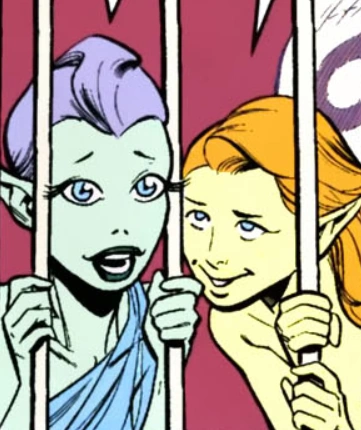 |
Original source
Moth is based on the character of the same name from Shakespeare's A Midsummer Night's Dream. | |

The mouse and the bumble-bee
|
|
 | |
Original source
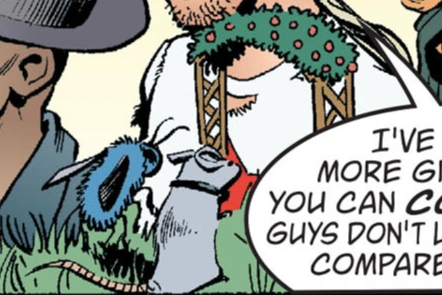
They are based on the characters from the nursery rhyme "A Cat Came Fiddling." | ||

Mrs. Finch
| Mrs. Finch is a Fable who resides at the Farm and appears in Fables #89 — "Baba Yaga: Chapter Three of Witches." She is also mentioned in Fables #90 — "Ozma: Chapter Four of Witches." Mrs. Finch was killed by Mister Dark while on a reconnaissance mission and, since birds have no teeth, she was not temporarily resurrected as a slave by her murderer. | 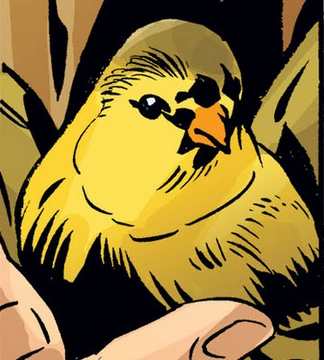 |

Ms. Magpie
| Ms. Magpie is an avian Fable who used to reside at the Farm and is mentioned in Fairest #29 — "Sail Away: Chapter Three of The Clamour for Glamour." She used to live in a little house tucked away within a tree, where a set of stairs had been carefully constructed to allow Fables without wings to enter. The residence is filled with trinkets and baubles that the owner has amassed in her natural affinity for shiny objects. After Ms. Magpie departs for the Homelands, Pussy Cat claims the space for herself and transforms it into a storage area for her collection of postcards and souvernirs from different places in the mundane world. | |
Mustardseed
| Mustardseed is a Fable who is imprisoned at the Golden Boughs Retirement Village. She first appears in Jack of Fables #3 — "You Don't Know Jack." | 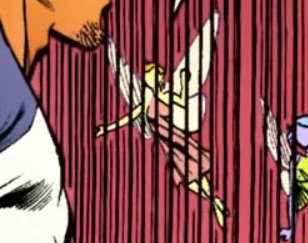 |
Original source
Mustardseed is based on the character of the same name from Shakespeare's A Midsummer Night's Dream. | |

N
Nauma
| Nauma is a Homelands character whose first appearance was in Fables #147 — "The Peaceable Kingdom: Chapter Seven of Happily Ever After." She was an elder sister to Lauda. | 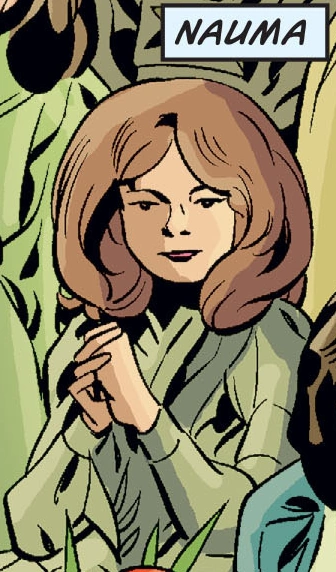 |

O
Omar
| Omar is a Fable who is a member of Bookburner's army of Forgotten Fables. He first appears in Jack of Fables #25 — "Turning Pages, Chapter 1: Robin." | 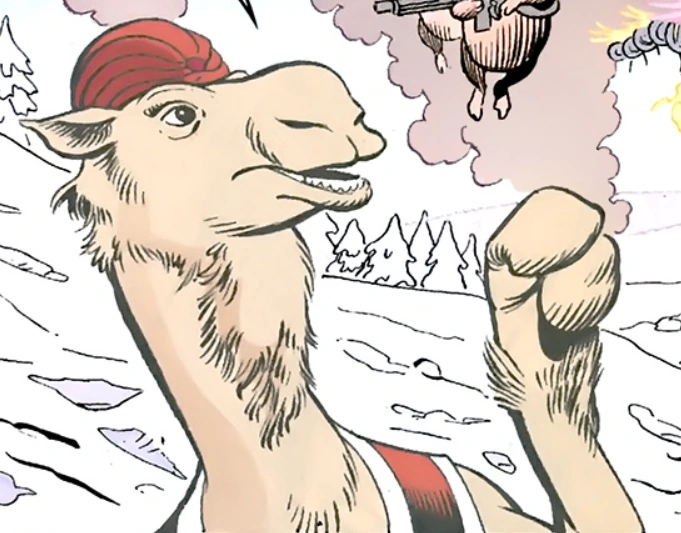 |

P
Peaseblossom
| Peaseblossom is a Fable fairy who is imprisoned at the Golden Boughs Retirement Village. She first appears in Jack of Fables #3 — "You Don't Know Jack." | |
Original source
Peaseblossom is based on the character of the same name from the play A Midsummer Night's Dream by William Shakespeare. | |
Pecos Bill
| Pecos Bill is a human Fable imprisoned at the Golden Boughs Retirement Village. He first appears in Jack of Fables #6 — "Jack Frost, Part One of Two." | 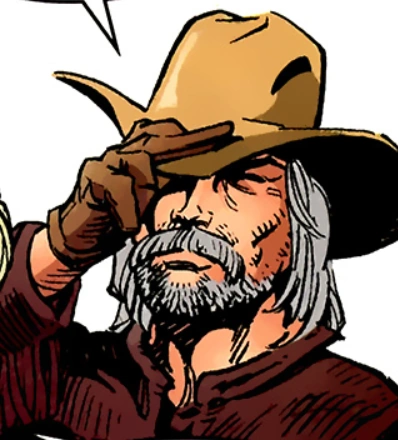 |
History
Pecos Bill escaped with Alice and John Henry during the big breakout from the Golden Boughs. The group briefly accompanied Jack Horner, who told them his story behind his identity as Jack Frost. He is present in the series' end battle, and is presumably killed off-screen. | |
Original source
Pecos Bill is based on the character of the same name from American folklore. The character was originally created by journalists, mainly Edward O'Reilly for The Century Magazine and was based on minimal genuine oral tradition. He is a legendary cowboy hero from the Pecos River area in Texas, embodying the exaggerated traits of Western endurance and principles; his vivid adventures are comparable to those of the mythical giant lumberjack Paul Bunyan. Pecos Bill is said to be born in Texas around 1832 and was brought up by coyotes after his parents lost him close to the Pecos River. As an adult, he rode a mountain lion and employed a rattlesnake as a lasso, defeating the most formidable cowboys. According to one legend, he passed away after consuming a meal of barbed wire followed by a drink of nitroglycerin.[44] | |

Piasa
| The Piasa first appears in Everafter: From the Pages of Fables #1 — "The Show Me State: Chapter One of The Pandora Protocol." It was among the many figures from St. Louis folklore that Jordan Yow raised from the collective unconscious.[7] | 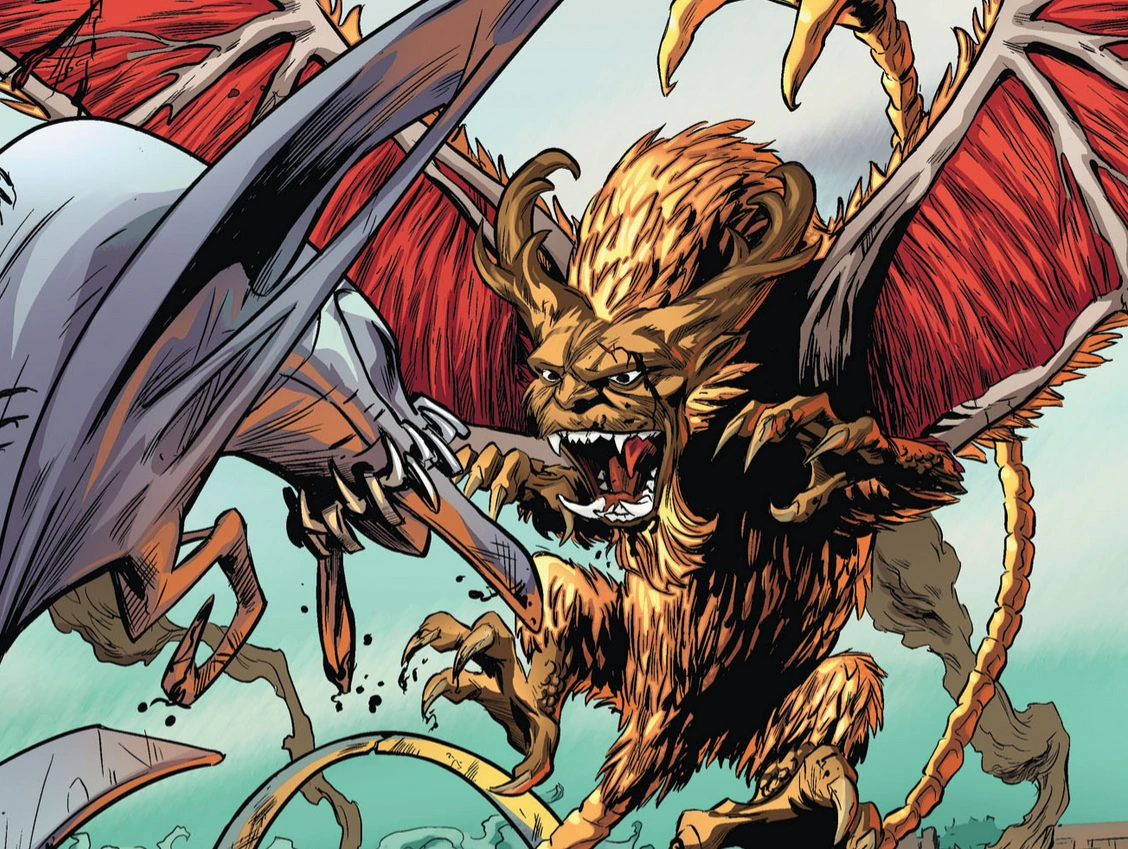 |
Original source
The Piasa is a creature from Native American mythology. | |

Piglet
|
|
 | |
History
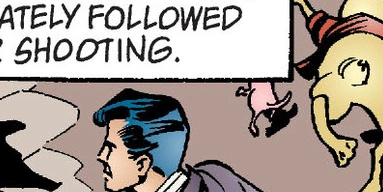
As Snow White questions Dun about Colin's murder, they stroll by what appears to be Winnie-the-Pooh, albeit without his signature red, short-sleeved T-shirt, accompanied by what appears to be Piglet, although the latter looks more like a pink teddy bear in this scene.[6] When the foiled revolution at the Farm threatens to flare up again, Piglet appears alongside Winnie-the-Pooh in two panels; from a distance when Boy Blue tells everyone to move back, and then from behind in the following panel, although in the latter, Piglet's head is obscured by a text box.[46] | ||
Original source
| ||

Pippin Pepper
| Pippin Pepper is a Fable that lives at the Farm. They are mentioned in Jack of Fables #23 — "1883, Chapter Two: Moon of the Wolf," where Incitatus refers to the character as a "church mouse." | |
Plano Goat Man
 | ||
Original source
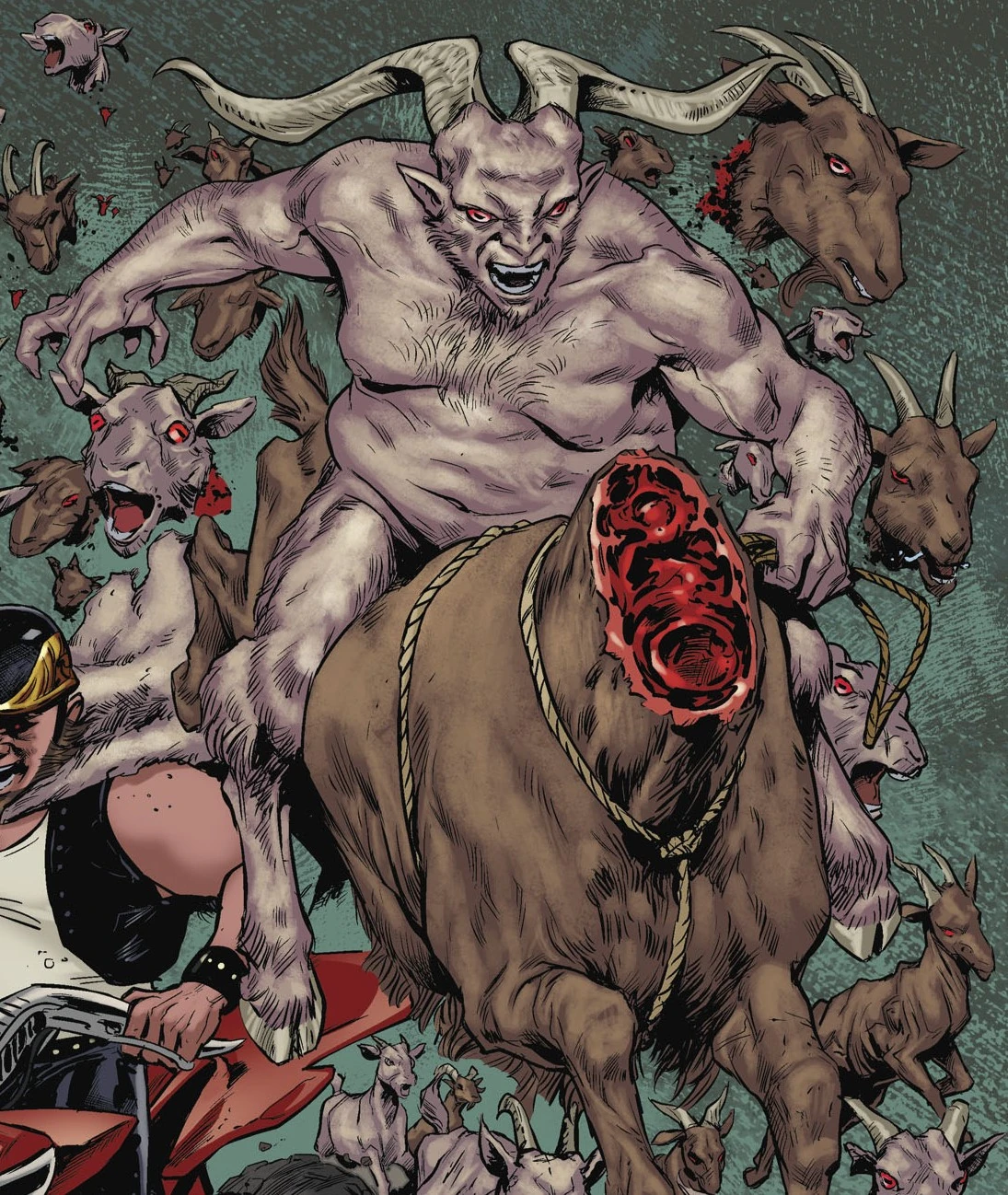
He is based on the Goat Man from a local urban legend from Plano, Texas.[47] | ||

The prince
| The prince is a human Fable who appears in flashbacks from the Homelands in Cinderella: From Fabletown with Love #6 — "Part Six: Ever After" and Fairest #10 — "The Hidden Kingdom Chapter Three: Lost in Translation." He had an affair with Rapunzel and got her pregnant. When Rapunzel was disowned and went looking for him, the Fairy Godmother prevented him from reuniting with her. | 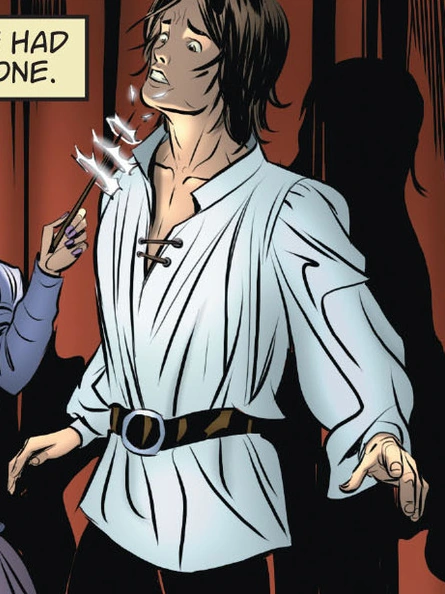 |
Original source
The prince is based on the character of the same name from the fairy tale of "Rapunzel." | |

Prince Charming's parents
| Prince Charming's parents are two Homelands characters who first appear in flashbacks in Fables: 1001 Nights of Snowfall — "The Fencing Lessons." | 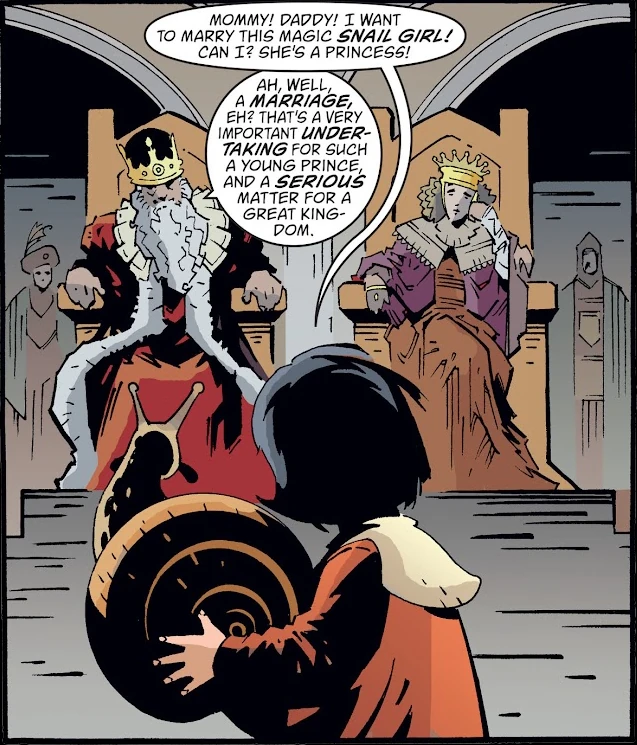 |
Original source
The father is based on the king from the "Cinderella" story, the prince's father from the fairy tale of "Snow White," and the prince's father from "Sleeping Beauty." The mother is based on the queen from "Cinderella" and the ogress queen from "Sleeping Beauty." | |

Prince Lawrence's parents
| Prince Lawrence's parents are Fables who first appear in a flashback from the Homelands in Fables: The Wolf Among Us #5 — "Chapter Five." | 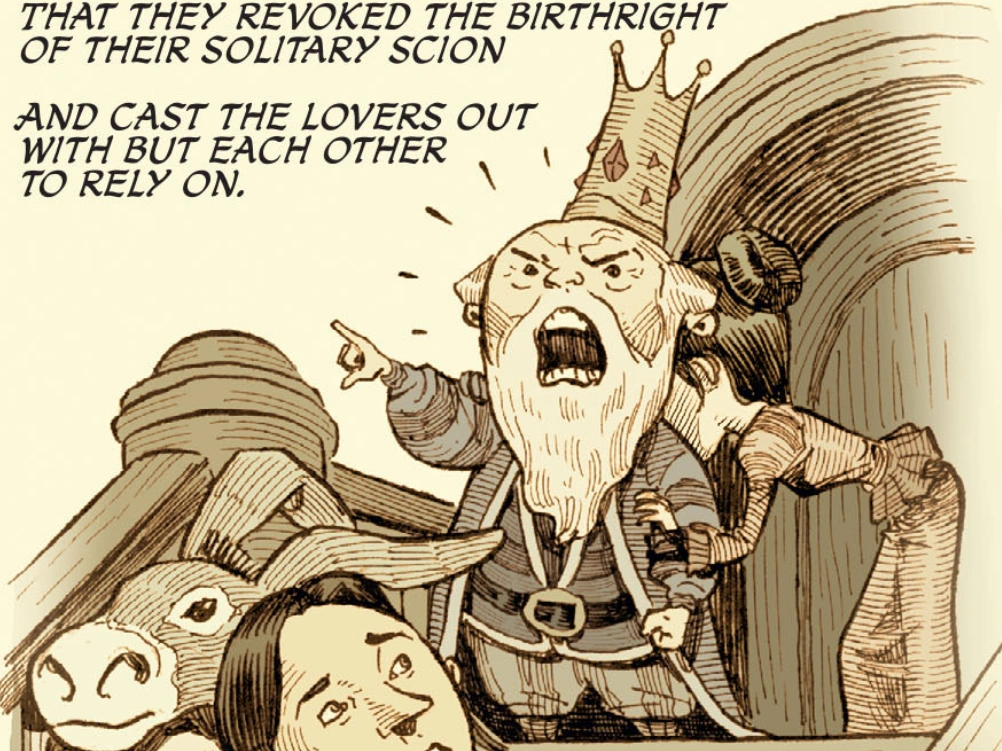 |
Original source
They are based on the Prince's parents from the "Donkeyskin" fairy tale. | |

Prince Lindworm
| Prince Lindworm is a Fable from the Homelands, who appears in Fables #107 — "Waking Beauty." He was beheaded by the Imperial General Mirant when Lindworm attempted to make himself the new Emperor in the wake of the defeat of the Adversary. He came back to life when his head was reunited with his body by his loyal goblin troops. | 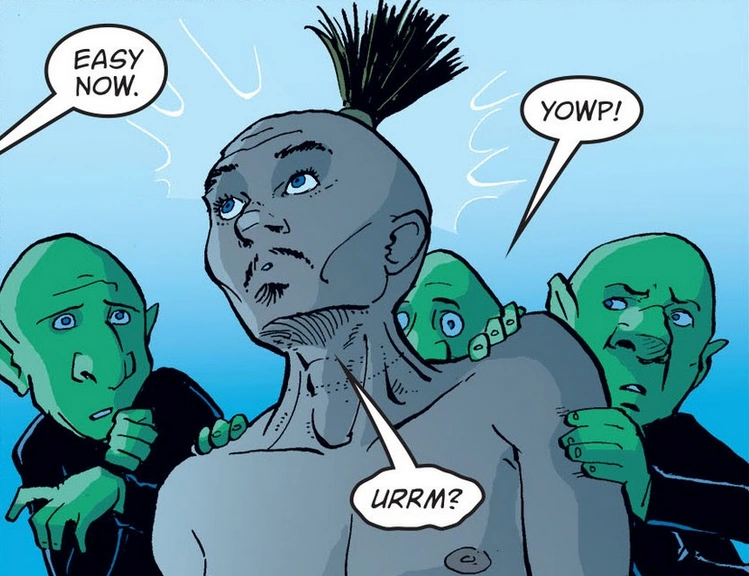 |
Original source
| |

Q
Queen Bee
| The Queen Bee, also known as Mrs. Bee, is a Fable that resides at the Farm, and is the leader of the bees who live in André Gardens. She appears in Fairest #30 — "Five Rhymes and a Riddle: Chapter Four of The Clamour for Glamour." | 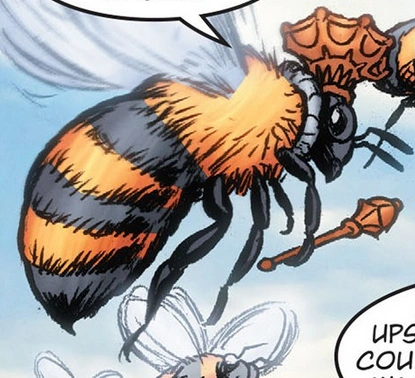 |
Original source
She is based on the queen of the bees from the Brothers Grimm fairy tale of "The Queen Bee," as well as one of the bees from Little Blossom, an obscure collection of poems from 1884, written and illustrated by the Victorian artist R. André; more specifically the poems "Mister Sunflower" and "The Battle of the Bee and the Snap Dragon." | |

Queen of Fairy
| The Queen of Fairy is a Fable fairy who is mentioned Fables: The Last Castle. Tam Lin claimed to be a knight who was loved by her. | |
Queen of the Golden Realm
|
 | |

R
Rangi
| Rangi is a Homelands character who appears in the chapter story Fables #150 — "The Last Snow Queen Story." He was the husband of Lumi, the Snow Queen, whom she freezes to death. | 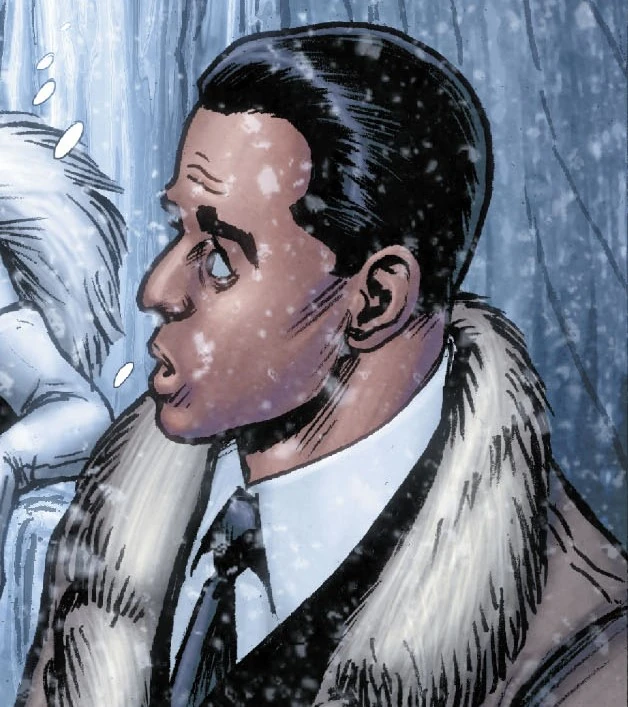 |

Red Cross Knight
| The Red Cross Knight is a human Fable who appears in flashbacks from the Homelands in Fables: The Last Castle. He was one of the Fables who fought at the keep at world's end. The Red Cross Knight almost won the battle at the all on his own, and could not be beaten, "not by goblin or troll or giant. Not by the dozens or the hundreds." He was finally killed when the enemy set a dragon against him. | 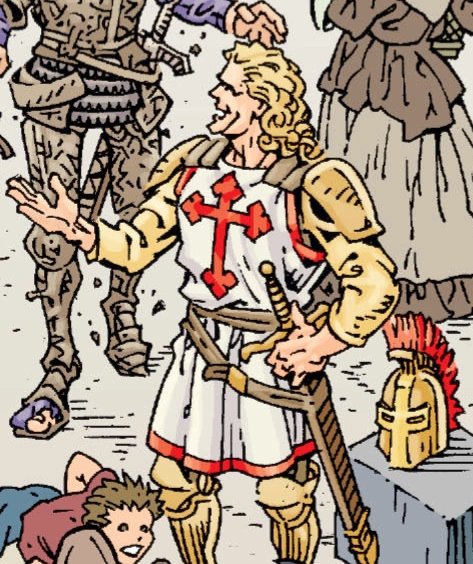 |
Original source
The Red Cross Knight is based on the Redcrosse Knight from Edmund Spenser's The Faerie Queene. The Redcrosse Knight is claimed to be Saint George, and Boy Blue's claim that he once killed a dragon seems to validate this connection, although they are not the same person, as the comic version of Saint George is seen alive and well in the 1940's Los Angeles. | |

Red Riding Hood impostor
| The Red Riding Hood impostor is a Fable from the Homelands who appears in flashbacks in Fables: The Last Castle. She was a sorceress and one of several spies working the Adversary who took the form of Red Riding Hood.[50] She infiltrated the keep at world's end and had a relationship with Boy Blue. Eventually, she ran out into a swarm of goblins after she thought that Blue had died, and was killed in the process. | 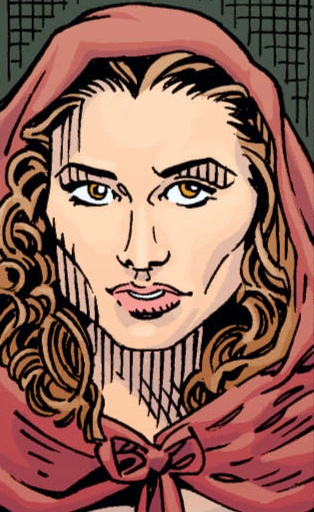 |

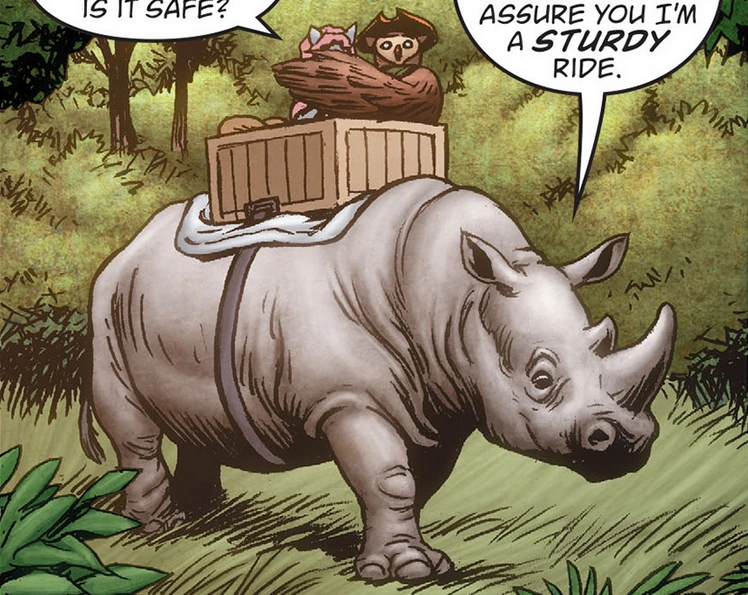
The Rhinoceros' calf
|
 | |
History
It is the calf of the Rhinoceros who was killed during the Battle of Fabletown in Fables #26 — "The Battle of Fabletown: Chapter Seven — March of the Wooden Soldiers." His offspring mentions their father as it takes the Owl and Pussy Cat on a little journey. | ||

Robin Redbreast
| Robin Redbreast is a Fable who is mentioned in Cinderella: From Fabletown with Love #1 — "Part One: Stopping Traffic." He is Jenny Wren's lost love, who was murdered during the Adversary's invasion of Jenny Wren's homeland. | |
Original source
| |
Ronald Levine
| Ronald Levine is a mundy who appears in a flashback story in Fables #28 — "Dog Company: War Stories, Part One" and Fables #29 — "Frankenstein Versus the Wolf Man: War Stories, Part Two." He was the leader of Bigby Wolf's platoon from World War II. | 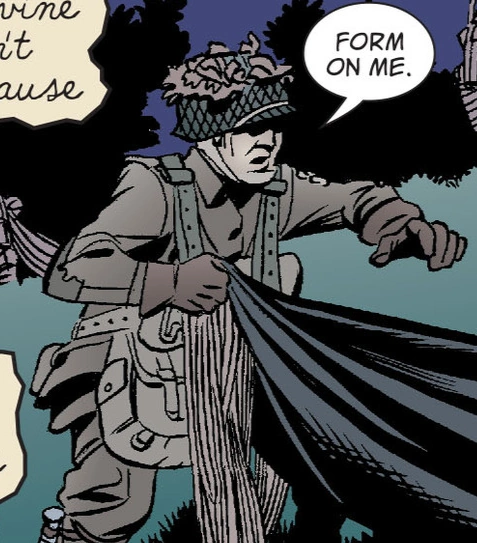 |

S
Saint George
| Saint George is a Fable who appears in Fairest #7 — "Lamia." He is a detective tracking down the issue's title character — the Lamia, a.k.a. Beauty — in a story set in 1940s Los Angeles. With the sword Ascalon, he had slain the dragon in his Homeland of Silene. With it, he also slew the beast Chimæra, the dragon Illuyankas, the dragon Tiamat and the serpent Vritra. It is strongly implied that Beast kills Saint George in order to protect Beauty. | 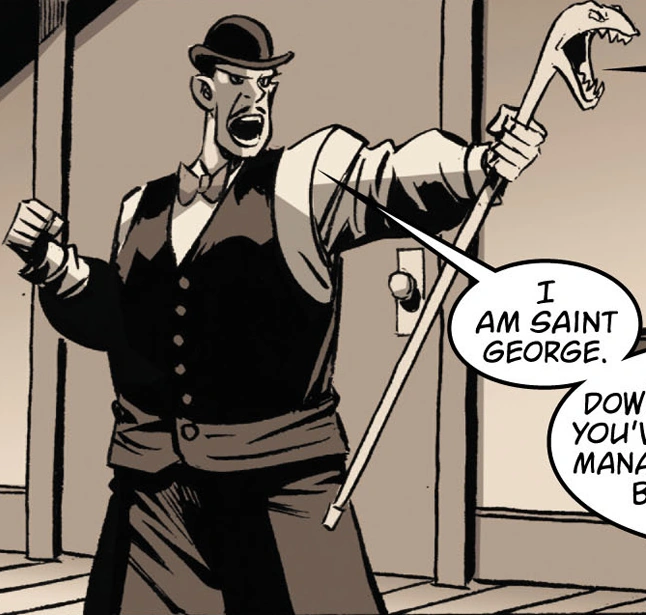 |
Original source
| |

Sally Morrison
| Sally Morrison is a Fable (presumably human) who lives in the state of New York (either in Fabletown, somewhere else in New York City, or the Farm). She is mentioned in Fables #33 — "Until the Spring," and was one of the people accidentally killed by Ghost. | |
Sancho Panza
| Sancho Panza[14] is a Fable that appears in a brief flashback from the Homelands in Fables #4 — "Chapter Four: Remembrance Day," appearing in a single panel alongside Don Quixote as they watch as ships come in after the Adversary's forces attack. | 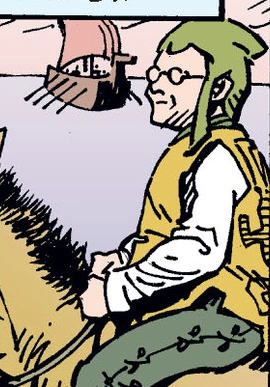 |
Original source
Sancho Panza is based on the character of the same name from the novel Don Quixote by Miguel de Cervantes. | |

Saunders
| Saunders is a Fable sock monkey who appears in flashbacks in Jack of Fables #36 — "Jack 'n' Apes." | 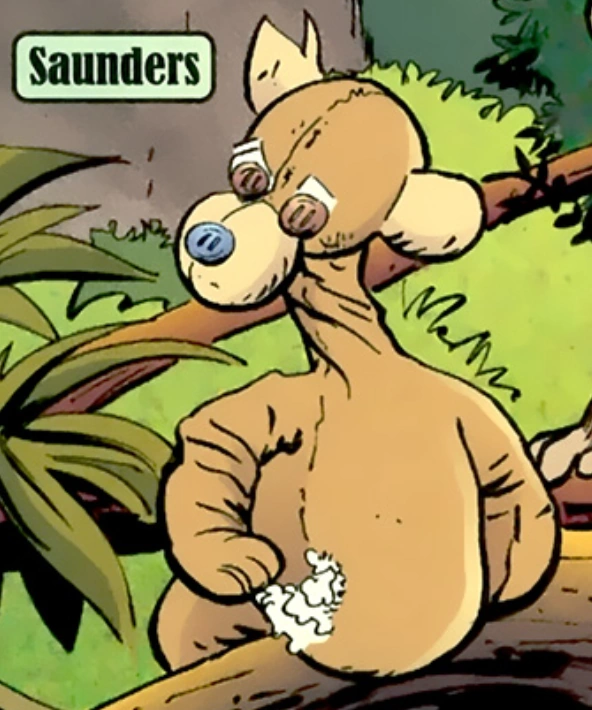 |
History
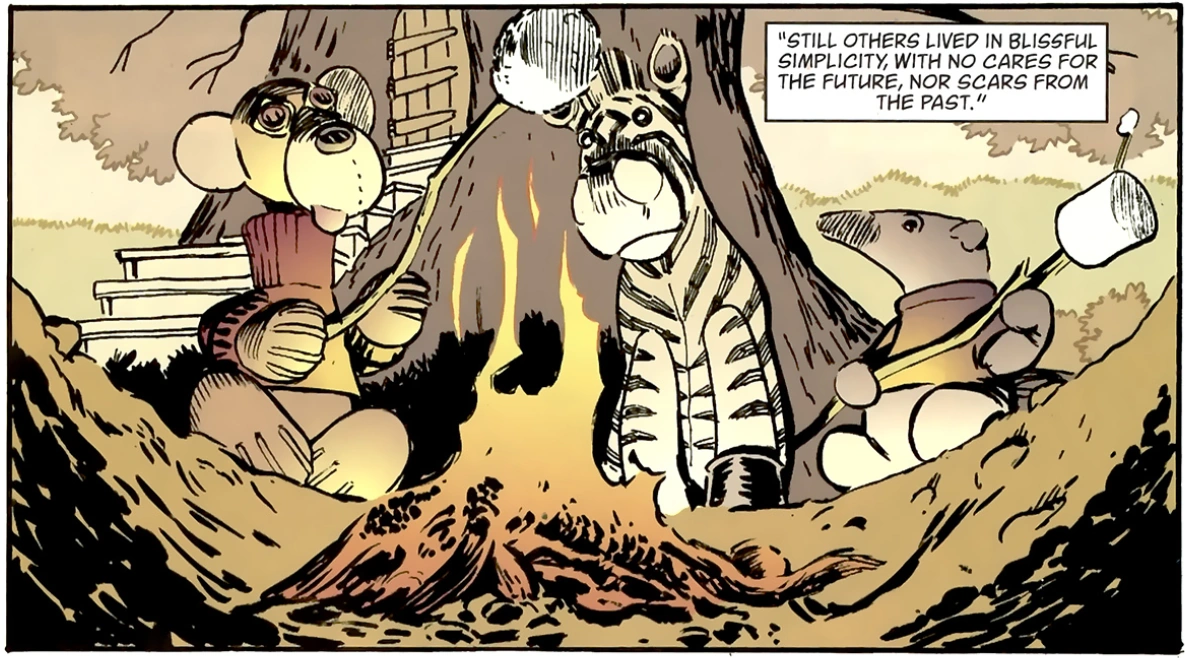 Saunders and what appears to be Winnie-the-Pooh (on the right) in the Hundred Acre Wood | |
Original source
He appears to be a reference to A. A. Milne's Winnie-the-Pooh; in Milne's novel, "Sanders" is the name of the person who resided at Winnie-the-Pooh's home prior to Pooh making it his house.[54] | |


Sea monsters
| The sea monsters are Fables from the Homelands and are mentioned in Fables: The Wolf Among Us #11 — "Chapter Eleven." According to Bigby, Beowulf fought off these sea monsters before he became the King of the Geats. | |
Original source
They are based on the nicors (sea monsters) from epic poem Beowulf. | |
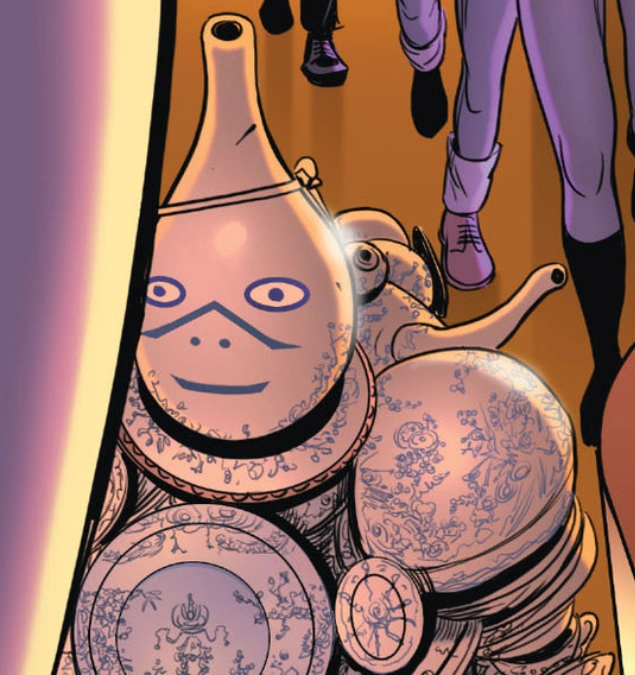
Seto Taishō
|
|
 | |
Original source
He is based on Seto taishō ("General Seto"), also known as the crockery general, from Japanese folklore. | ||

The seven brothers
| Four of the seven brothers briefly appear in a flashback from 1984 set in Thailand, in Cinderella: Fables Are Forever #3 — "Part Three." | 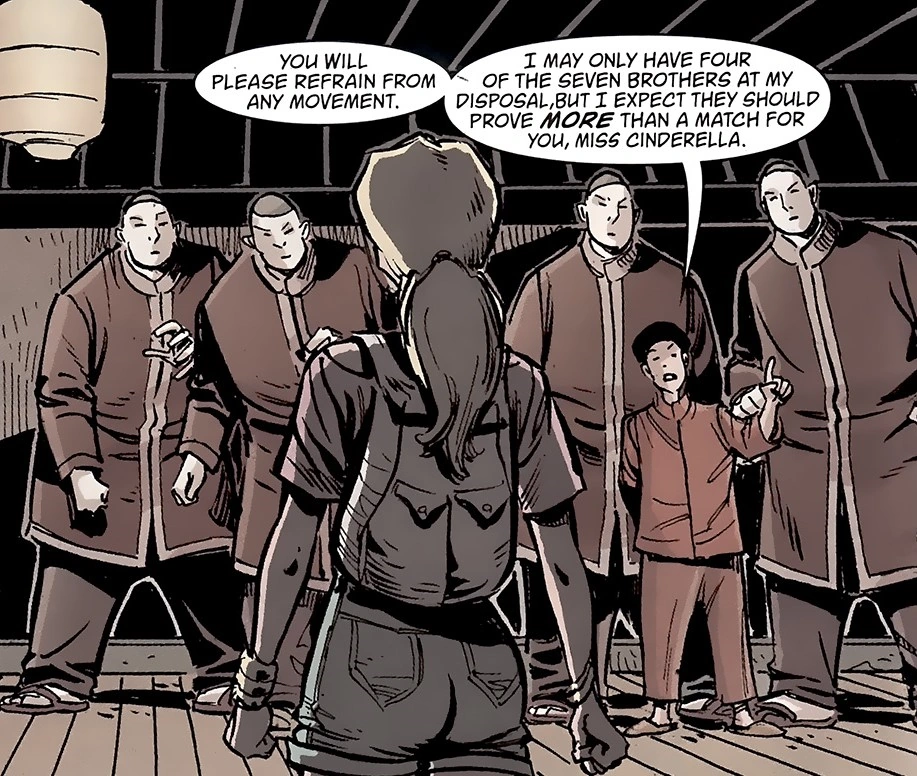 |
Original source
They are based on the titular characters of the Chinese legend of the Ten Brothers, although the number of brothers in the story differs among various versions of the folktale. | |

Sir Geoffrey
| Sir Geoffrey is a Homelands character who appears in flashbacks in Fables #97 — "Dark Age Party Girl, Chapter Four of Rose Red." | 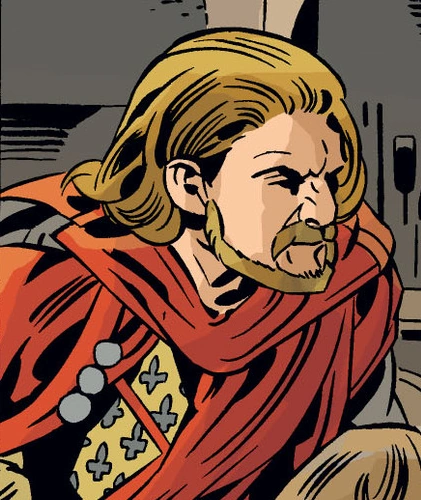 |

Sir Herman Von Starkenfaust
| Sir Herman Von Starkenfaust is a Fable who appears in flashbacks from the Homelands in Fables: The Last Castle. According to Boy Blue, he turned out not being a ghost after all. |  |
Original source
He is based on the character of the same name from Washington Irving's short story "The Spectre Bridegroom." | |

Sir Morwen
| Sir Morwen is a Homelands character whose only appearance was in Fables #97 — "Dark Age Party Girl, Chapter Four of Rose Red." | 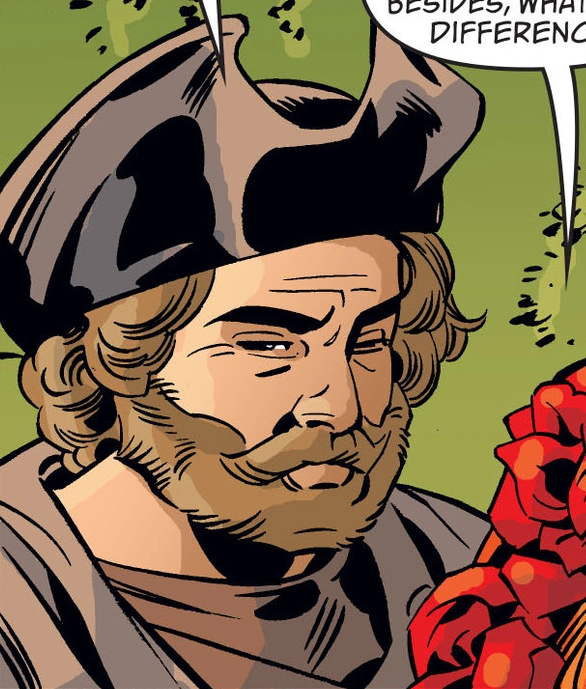 |

Sir Roland
| Sir Roland is a Homelands character who appears in Fables #97 — "Dark Age Party Girl, Chapter Four of Rose Red." | 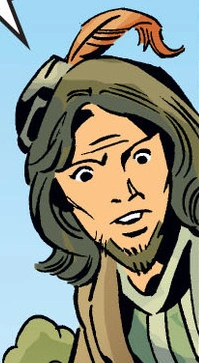 |

Spoon Brigade
| The Spoon Brigade[55] are Fables from Oz and first appear in Cinderella: Fables Are Forever #1 — "Part One." They are Fables recruited by Dorothy Gale to aid her in her plot for revenge on her arch nemesis, Cinderella. |  |
Original source
The Spoon Brigade are based on the organization from The Emerald City of Oz. | |

Squire Polly
| Squire Polidorius Presterglorius, better known as Squire Polly, is an anthromorphic red panda from the world of the Hesse, who appears in Fables #151 — "The Black Forest Chapter One: Greenjack" and Fables #154 — "The Black Forest Chapter Four: Trouble," and appears as a corpse in Fables #158 — "The Black Forest Chapter Eight: Villainy." He is the Chief Magistrate of the district of the Black Forest where the Wolf family settles down in the wake of Fabletown's destruction.[56] | 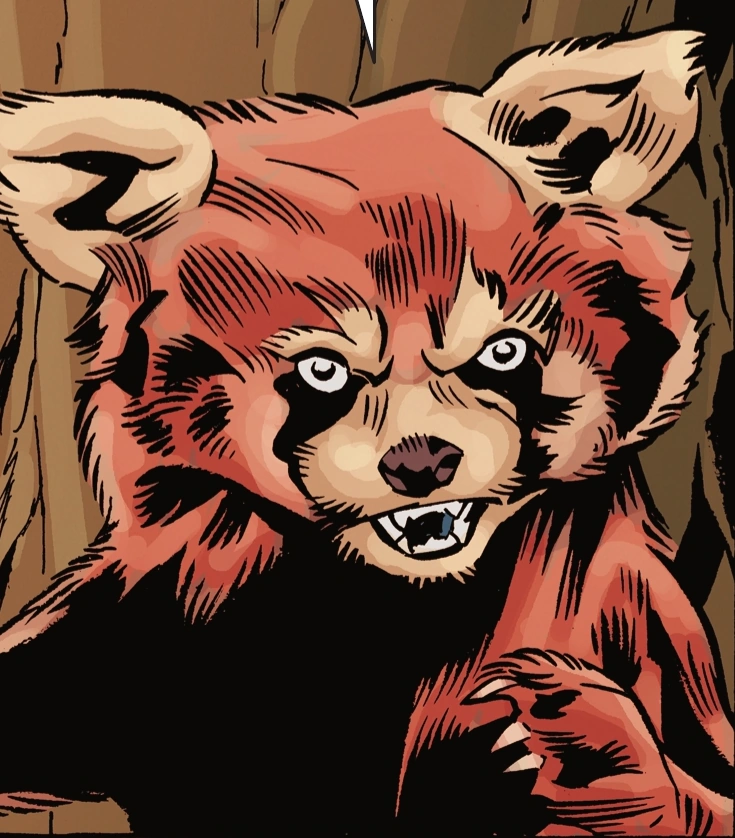 |

Stulla
| Stulla is a Homelands character who appears in Fables: 1001 Nights of Snowfall — "The Witch's Tale." She was a member of the Running River Tribe, rival of the Fog Mountain Tribe. She was married to Aurac to stem a conflict between their two tribes. | 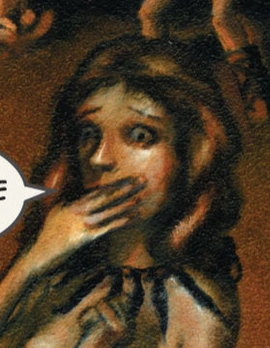 |

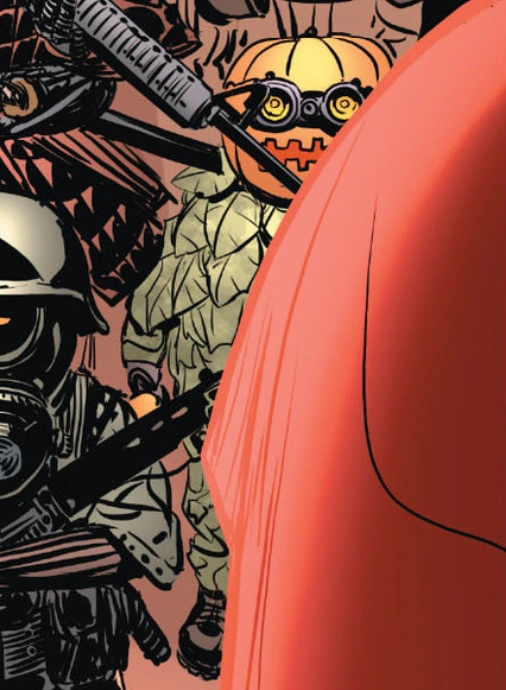
Sunamura no oryō
|
|
 | |
Original source
It is based on the Sunamura no onryō ("the ghost of Sunamura") from Japanese folklore. | ||

Supay
| Supay is a Fable deity who appears in Everafter: From the Pages of Fables #5 — "Turn and Face the Strange: The Conclusion of The Pandora Protocol." | 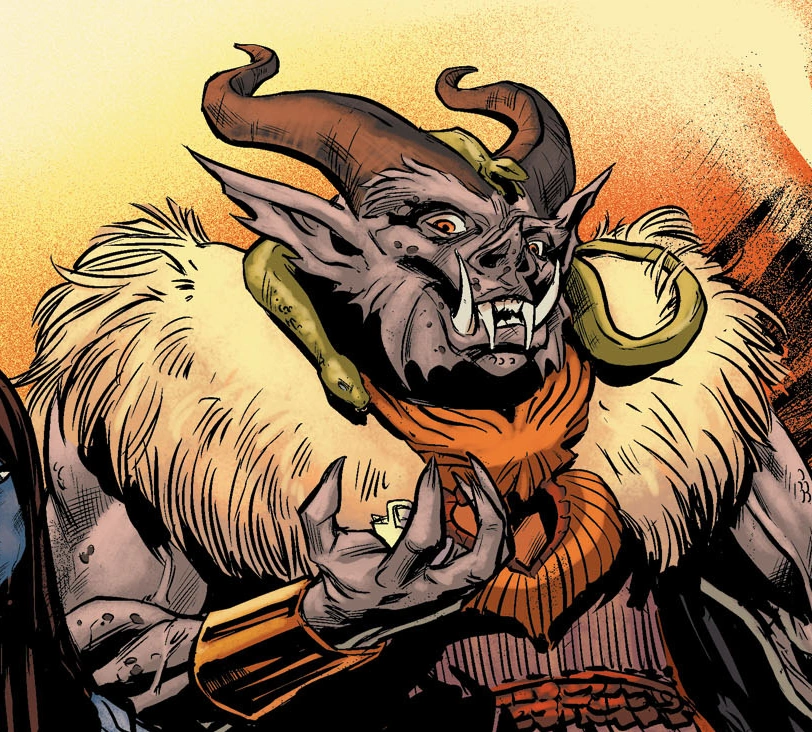 |
Original source
He is based on the deity from Aymara and Inca mythology. | |

The swallow
|
|
 | |
Original source
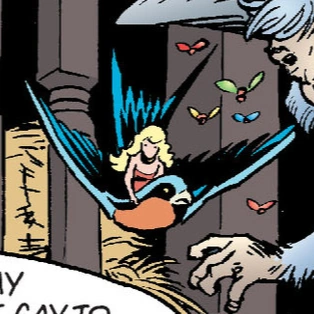
It is based on the character of the same name from the "Thumbelina" fairy tale. | ||

Syala
| Syala is a Homelands character whose first appearance was in the issue Fables #147 — "The Peaceable Kingdom: Chapter Seven of Happily Ever After." She was an elder sister to Lauda. | 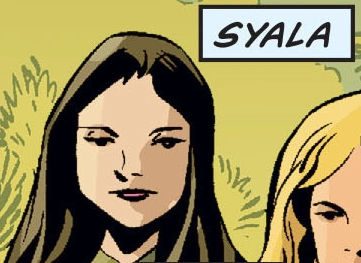 |

Syksy
| Syksy is a Homelands character who appears in flashbacks in Jack of Fables #6 — "Jack Frost, Part One of Two" and Jack of Fables #11 — "Jack Frost, Part Two (of Two)." She is one of Lumi's three sisters and aunt to Lumi's son Jack Frost. Syksy is the Autumn Queen, and wherever she lives, it will be fall. | 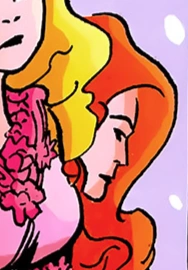 |

T
Tam Lin
| Tam Lin is a Fable who appears in flashbacks from the Homelands in Fables: The Last Castle. He claimed to be the knight loved by the Queen of Fairy. He had a reputation of a scoundrel, but after winning a place for himself on the last ship out of the Homelands, he gave it to his young page instead. | 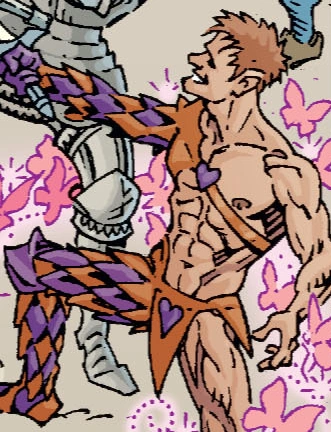 |
Original source
Tam Lin is based on the titular character of the traditional Scottish ballad. | |

Tannika Wynn
| Tannika Wynn is a Homelands character who appears in Fables #150 — "The Last Snow and Bigby Story." She is a descendant of Bigby Wolf and Snow White. Together with Etan Wolf, she escorted Rose Red to their family reunion. | 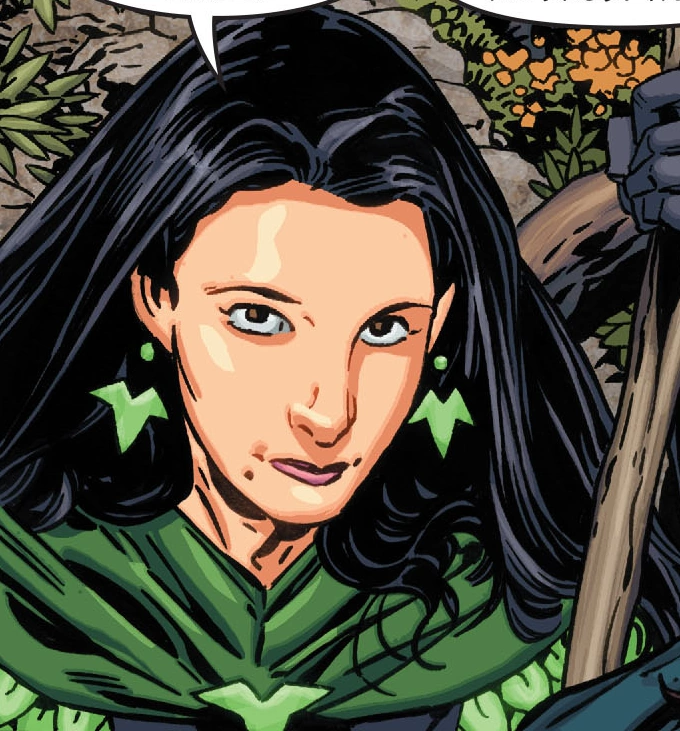 |

Tesso
|
|
 | |
Original source
| ||

Tobba
| Tobba is a Homelands character whose first appearance was in Fables #147 — "The Peaceable Kingdom: Chapter Seven of Happily Ever After." She was an elder sister to Lauda. | 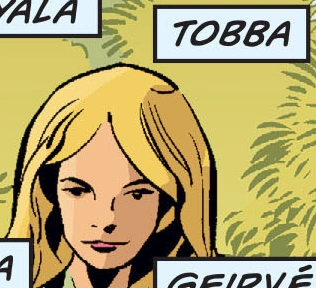 |

Tosh
| Tosh, the King Under the Earth, appears in Fables: 1001 Nights of Snowfall — "The Fencing Lessons." He is the king of the dwarves in the land below Prince Charming's kingdom, during the years in which Prince Charming is married to Snow White. When Snow began killing the seven dwarves who had kept her prisoner, Tosh threatened war with Prince Charming's kingdom. Ultimately, Charming discovered his wife's secret murders and conspired to conceal them, placing the blame on a convicted felon and averting war. | 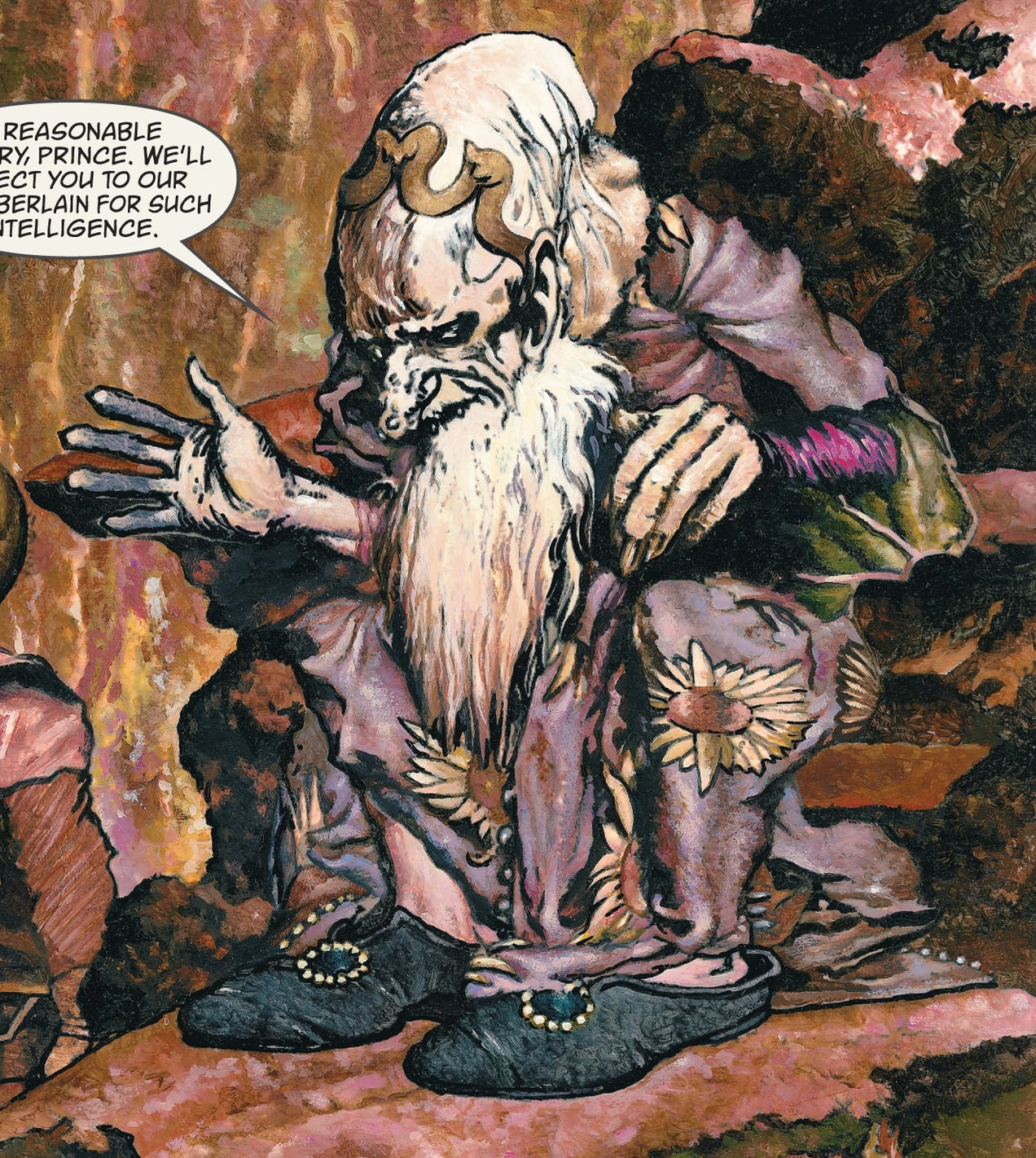 |

Trotty Veck
| Trotty Veck is a Fable who lives at the Farm. He appears in Fairest #14 — "Aldered States" and is an elderly man who works in the milking sheds. He tries — and fails at — courting Princess Alder. | 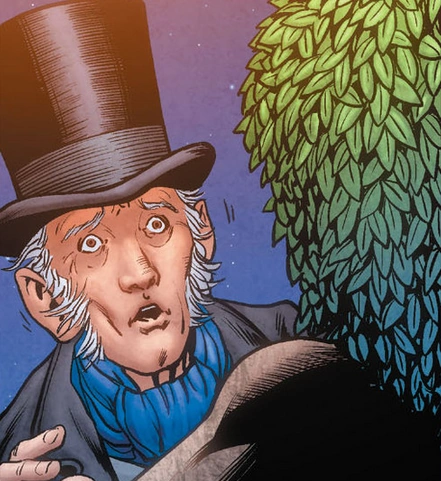 |
Original source
Trotty Veck is based on the character of the same name from the novella The Chimes by Charles Dickens. | |

Tsarevich Ivan
| The Tsarevich Ivan is a Fable from The Rus who is mentioned in Fables #37 — "The Saint George Syndrome: Chapter Two of Homelands Fables." He lives in a palace where a gateway to another world is found within his throne room. | |
Original source
Tsarevich Ivan is based on Ivan Tsarevich from Russian folklore. | |
Tugarin Zmeyevich
| Tugarin Zmeyevich is a Fable who appears in flashbacks in Cinderella: Fables Are Forever #1 — "Part One" and Cinderella: Fables Are Forever #2 — "Part Two." He is a dragon who can take the shape of a man, and is the head of one of the hidden Fable communities in Russia.[59] These communities are scattered throughout the mundane world, and are collectively known as Shadow Fabletown.[60] |  |
Original source
Tugarin Zmeyevich is based on the mythical creature of the same name from Slavic mythology. | |

V
Valka
| Valka is a Homelands character whose first appearance was in Fables #147 — "The Peaceable Kingdom: Chapter Seven of Happily Ever After." She was an elder sister to Lauda. | 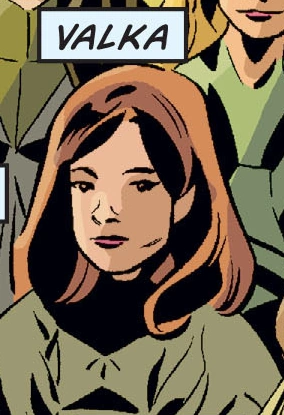 |

Veruna
| Veruna is an aquatic Fable creature, with the head of a tiger and the body of an enormous fish. It appears in Fairest #25 — "Of Men and Mice, Part Five: Mousetrap." In Deshnok, India, Veruna comes to Cinderella's rescue when her stepsister tries to murder her on a boat. The creature takes care of the stepsister by consuming her whole and spitting out her armored metal boots. Veruna then graciously delivers Cindy and her companions to New York City. | 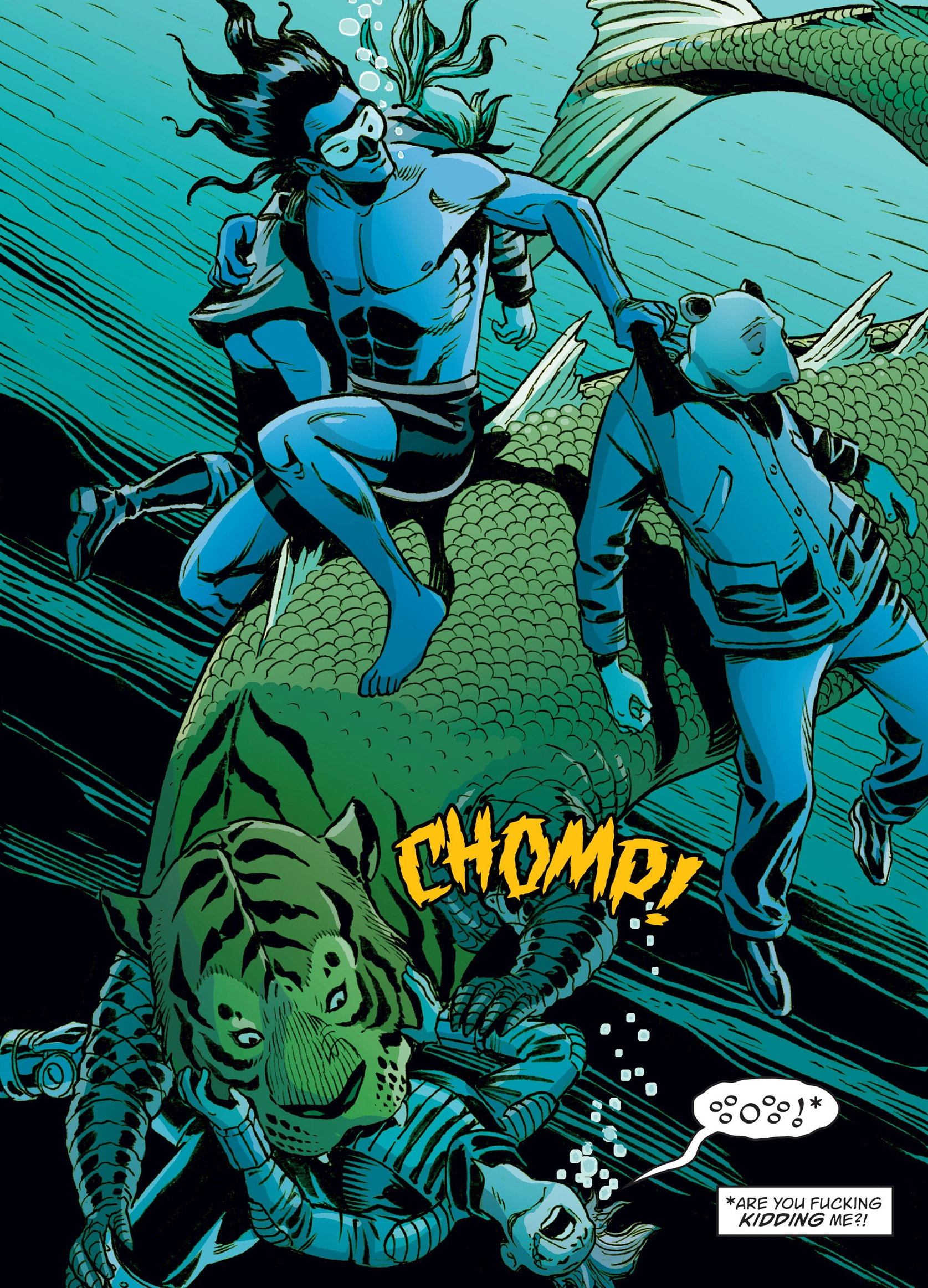 |
Original source
| |

W
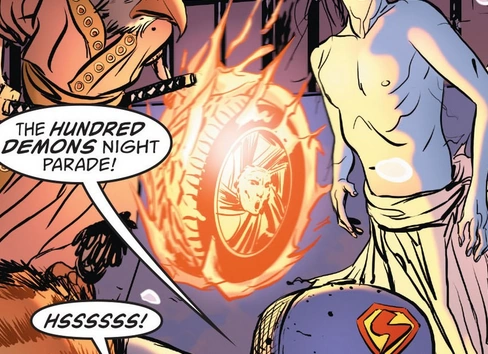
Wanyūdō
|
|
 | |
History
When Tomoko went to war with Katagiri, the latter sent out a multitude of magical origami cranes to gather all the hidden Japanese Fables and call them to his cause. Wanyūdō heard his summons and proceeded to join Katagiri's ragtag army of yokai. Tomoko was livid at the yokai who had chosen to support her opponent, and she harshly criticized them for emerging from their places of seclusion to fight alongside a "decripit turtle." | ||
Original source
It is based on the Wanyūdō ("wheel monk") from Japanese folklore. | ||

Wicked Witch of the East
| The Wicked Witch of the East is a Fable who briefly appears in a flashback from the Homelands in Cinderella: Fables Are Forever #4 — "Part Four." Her demise was unintended, but she met her end when the house of Dorothy Gale came crashing down on top of her, signifying Dorothy's loss of innocence. | 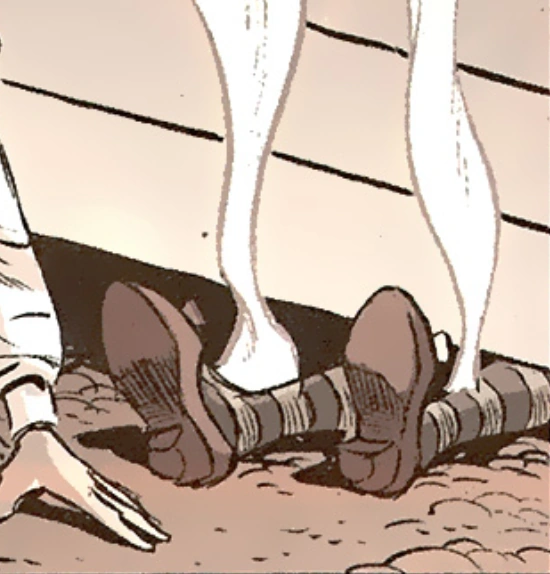 |
Original source
She is based on the Wicked Witch of the East from the children's novels The Wonderful Wizard of Oz and The Tin Woodman of Oz. In the issue, she is merely referred to as "a witch"; however, Dorothy uses the pun "Wicked Bitch of the East" in Cinderella: Fables Are Forever #1 — "Part One." | |

Wicked Witch of the West
|
|
 | |
History
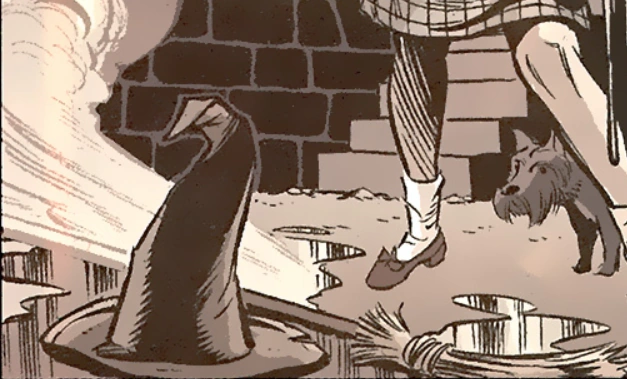
Bufkin was part of the Wicked Witch of the West's air force, her elite shock troops.[62] Having inadvertently taken the life of the Wicked Witch of the East, Dorothy Gale was asked by the Wizard of Oz to do away with her other counterpart. We get a glimpse of her dissolved figure as Dorothy dispatches her using a pail of water.[63] | ||
Original source
She is based on the Wicked Witch of the West from the children's novel The Wonderful Wizard of Oz. In the comics, she is merely referred to as an unnamed witch. | ||

Wizard of Oz
|
|
 | |
Original source
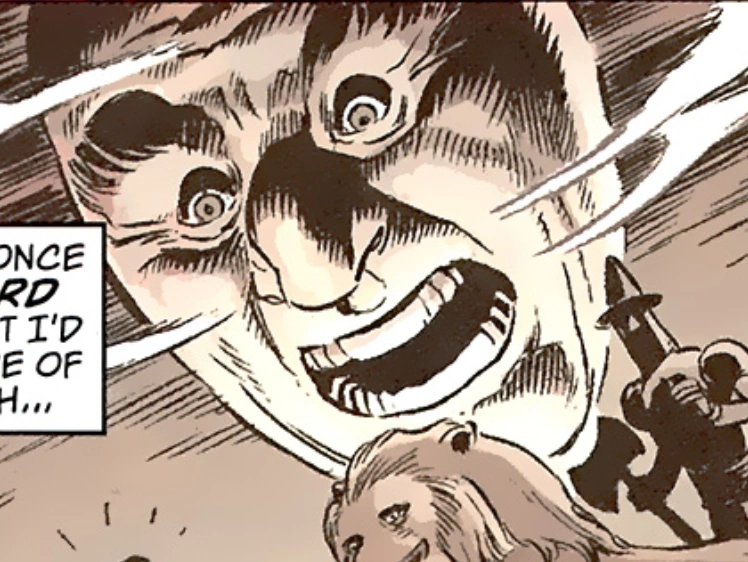
He is based on the Wizard of Oz from the children's novel The Wonderful Wizard of Oz, and its many sequels. In the comic, he is merely referred to as "the wizard." | ||

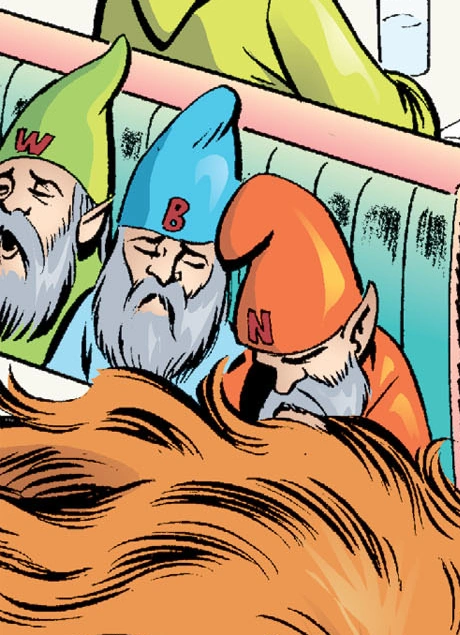
Wynken, Blynken, and Nod
|
|
 | |
Original source
They are based on titular characters of the children's poem "Wynken, Blynken, and Nod" by Eugene Field. | ||

Y
Z
Zilmer
| Zilmer is a mundy who fought alongside Bigby Wolf during World War II, in a flashback story from Fables #28 — "Dog Company: War Stories, Part One" and Fables #29 — "Frankenstein Versus the Wolf Man: War Stories, Part Two." He eventually died of old age. | 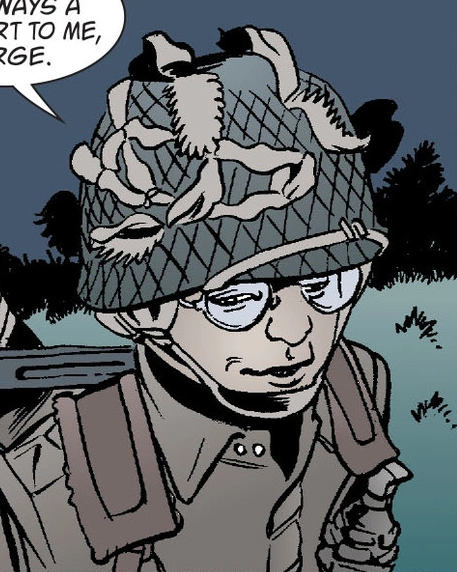 |

Zombies from Zombie Road
| The zombies from Zombie Road are zombie creatures that first appear in Everafter: From the Pages of Fables #1 — "The Show Me State: Chapter One of The Pandora Protocol." They were among the many figures from St. Louis folklore that Jordan Yow raised from the collective unconscious.[7] | 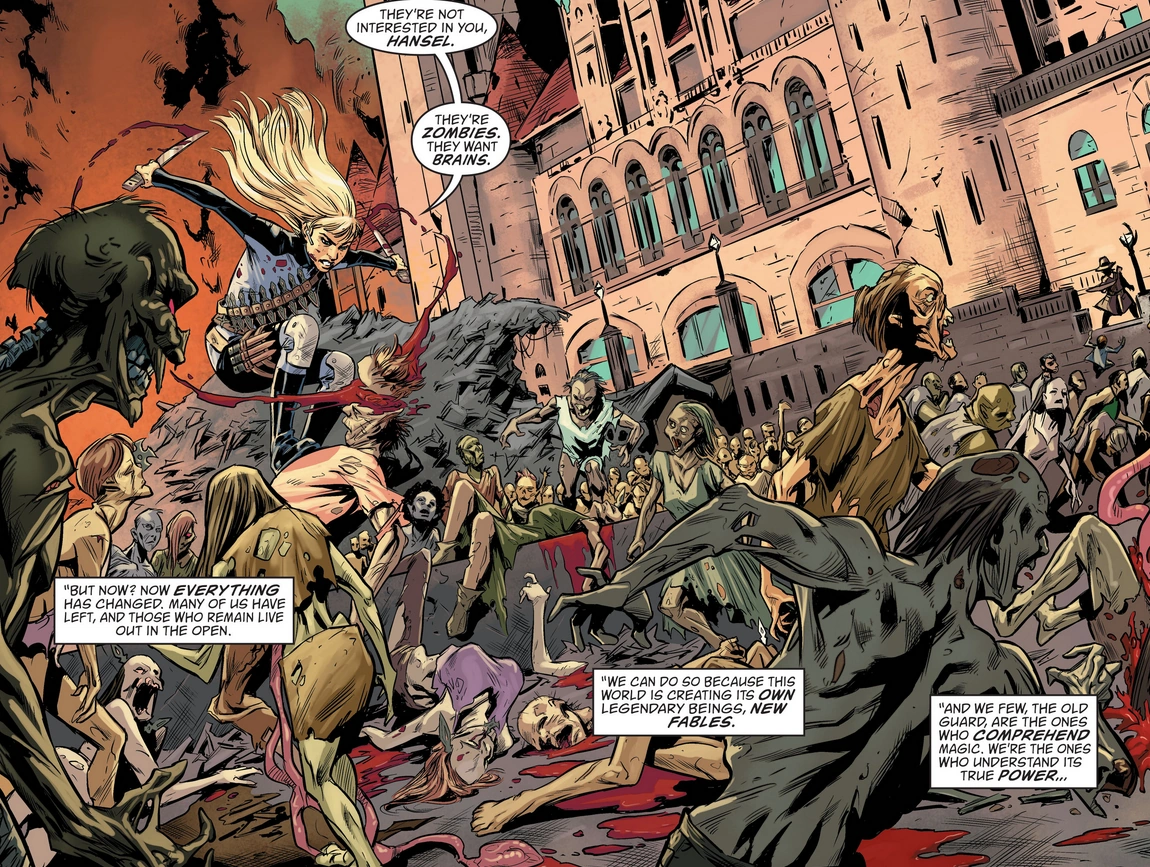 |
Original source
The zombies are a reference to Zombie Road, a trail through the woods of St. Louis County, Missouri, said to be one of the most haunted roads on the planet.[64] | |

References
|