| “ | You're Isengrim from King Noble's bunch, right? | „ |
| ― Bigby Wolf to Isengrim, Fables #53 — "Sons of the Empire, Part Two: The Four Plagues" |
Isengrim is a Fable wolf who lives on the Farm in upstate New York. He debuts in Fables #53 — "Sons of the Empire, Part Two: The Four Plagues."
History
Exile
Isengrim was one the subjects of King Noble[1] and resided in an vast sprawling valley, sharing this territory with the other subjects under Noble's rule. One day, however, their valley was occupied by the armies of the Adversary. The invaders let Noble continue to rule, as long as he kept his subjects pacified and paid taxes to the Empire. However, they were not allowed to celebrate Christmas, and the enemy seized the forest's magic gateway that lead to the mundane world, and arrested anyone who attempted to flee through it. Isengrim and the rest of King Noble's people, desiring freedom from the evil oppressors, eventually found a way to escape through the gateway after Reynard the Fox tricked the goblin soldiers into leaving it unguarded for one night, and leaving food for the animal Fables.[2]
The Farm
Many years later at the Farm, Isengrim and Brer Wolf endeavor to hunt and kill Peter Cottontail. However, their pursuit is unsuccessful; when they relentlessly pursue Peter into Wolf Valley, they are met with a warning from Bigby Wolf. They try to defend their intrusion by stating that they are wolves, but Bigby rightly asserts that they are not members of his pack. Humiliated, the two are obliged to leave.[1]
Threat of Mister Dark
King Noble, like many other Fables, isn't pleased to have the Adversary, Geppetto, a citizen of Fabletown. When Geppetto is brought to the Farm, Noble recruits Isengrim along with a handful of other animals from Noble's former royal subjects; Reynard the Fox, Brun and Belin. They try to kill him, but the magic shielding Geppetto proves too strong. Geppetto chastises them for daring to attack him, but the group is undeterred; since they cannot kill him, they follow Reynard's advice and bury him alive in a deep hole.[3]
Appearances
Fables
- Fables #53 (first appearance)
- Fables: 1001 Nights of Snowfall (flashback)
- Fables #81
Original source
Isengrim is based on the character of the same name from many medieval European beast epics. He is a greedy and dim-witted wolf, who is often portrayed as a worldly and corrupt churchman. Isengrim first appears as an unnamed character in the Latin Ecbasis captivi (from c. 940), and under his own name in Ysengrimus from 1152. In both epics, he serves as the main character. In the first story, he is depicted as a monk, symbolizing the slothful and degenerate clergy of that era, while in one episode of Ysengrimus, Reynard the Fox deceives him into becoming a monk by claiming that the food in monasteries is excellent. While Isengrim is being tonsured and ordained amidst blows and insults, Reynard visits his home and possesses his wife.[4] Isengrim is a supporting character in the medieval literary cycle of Reynard the Fox, which encompasses Dutch, Flemish, French, German, and English stories,[5] where the titular character takes the place of the wolf as the main character in the beast epics following Ysengrimus.[4]
In the Reynard cycle, Isengrim is also known as Isegrim, Isegrym, Isengrim, Isengrin, Issangrin, Isengijn, Sigrim, Ysegrim, Ysengrimus, and Ysengrim. He is the husband of the she-wolf Hersent, the father of the wolves Pinchart and Primaut, and the uncle of Reynard, the fox. He is sometimes Reynard's friend, and sometimes his worst enemy.[6]
Please note: Isengrim is named and identified as one of King Noble's people in Fables #53 — "Sons of the Empire, Part Two: The Four Plagues," but the wolf that appears alongside King Noble in Fables: 1001 Nights of Snowfall — "The Christmas Pies" and Fables #81 — "The Blue Horizon: Chapter Five of the Dark Ages" is unnamed. Although there are three other prominent wolves within the literary cycle, this article assumes that the unnamed wolf at King Nobe's side is also Isengrim, as he appears in significantly more texts from this cycle than the other three "wolf candidates"[6] and is also known from other medieval stories beside Reynard the Fox.[4]
Trivia
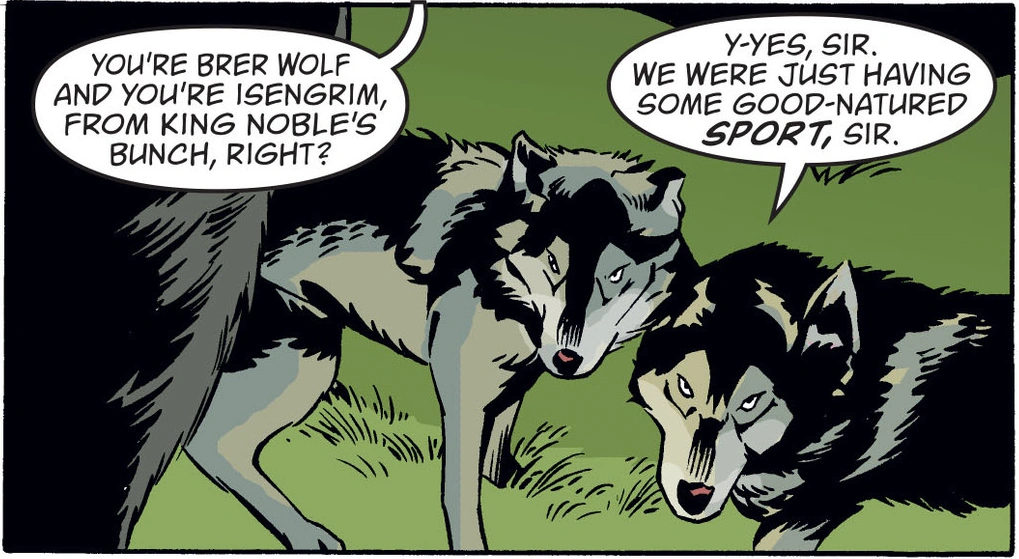

Brer Wolf to the left, Isengrim to the right
When Isengrim and Brer Wolf are chasing Peter Cottontail in Fables #53 — "Sons of the Empire, Part Two: The Four Plagues," the story does not specify which one of the wolves is Isengrim.[1] In the Fables Encyclopedia, Fables penciler Mark Buckingham states that he made Isengrim's fur a little darker and his ears have sharper points.[7] However, this difference can only be clearly seen in the panel where Bigby Wolf identifies the two intruders.[1]
References
|